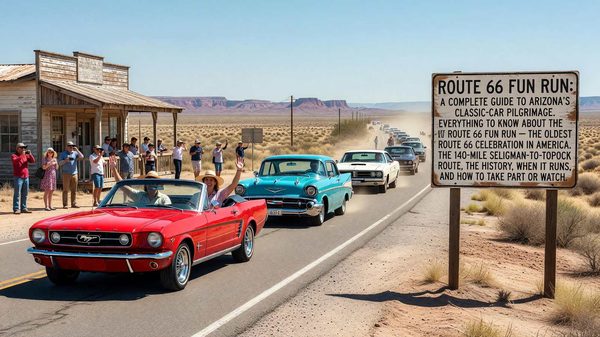
The Route 66 UltraRun covers the exact same 140 miles of historic Route 66 that the Fun Run caravan covers each May — Seligman west through Peach Springs, across the Hualapai lands, through Kingman, down the Black Mountains via Sitgreaves Pass, through Oatman, and finishing at Topock on the Arizona–California line. The difference is that instead of a weekend in a classic car, you cover it on foot, in November, with sixty hours to finish.
The 2026 edition runs November 14, making it this year’s fifth annual event and the centennial edition of the race — Route 66 turns 100 on November 11, 2026, three days before the start.
What the Event Actually Is
The Route 66 UltraRun is a point-to-point, non-looped, open-road ultramarathon on paved historic highway. It is crewed: each solo runner requires a support crew of two to four people who follow in a vehicle, managing nutrition, sleep, foot care, and the logistics of keeping someone moving across 140 miles of desert at all hours. Relay teams of three to six people divide the distance with no designated exchange points — the team determines its own handoffs.
There are no intermediate cutoffs. The sixty-hour window for the 140-mile race and the forty-eight-hour window for the new CenturyRun are generous by ultramarathon standards, designed for the road itself rather than a competitive clock. That framing shapes the entire event. This is not a race where people are being pulled at mile seventy for being too slow — it is a long, open, minimally governed effort to traverse a historic highway under your own power.
Registration is through UltraSignup and RunSignUp; historical results and course photos are on the event’s results page.
The Course: What 140 Miles of Route 66 Looks Like
The course starts in Seligman at roughly 5,200 feet elevation — nearly the same as Denver. That number is important because it means the first third of the race, from Seligman through Peach Springs, can see genuine winter conditions in November. Snow is possible on the opening 37 miles. Average November temperatures at the start range from 28°F overnight to around 62°F at midday. Runners who underestimate the altitude and cold in the first section create problems for themselves long before they reach the desert heat near the finish.
That temperature swing is the part newcomers to the course underestimate most. A runner who starts comfortably in a headlamp and a light jacket at 6:30 a.m. can be shedding layers by mid-morning and layering back up again once the sun drops the second night — crews packing for a 60-hour window need to plan for both ends of that range, not just the daytime forecast.
The course moves through distinct terrain zones that you would not fully appreciate on the drive:
Seligman to Peach Springs (roughly 37 miles): High-desert grassland at altitude. Open, exposed, and quiet. Burma Shave-style signs — a nod to the original roadside advertising of Route 66’s golden era — mark the corridor. Cattle graze in the wide valleys, and freight trains work the parallel rail line. This is the contemplative portion of the race, before the physical demands compound.
Peach Springs through the Hualapai Nation lands: The corridor drops into pinyon pine and juniper terrain, with the smell and shelter that comes with it. This is some of the most isolated highway in the state — there are very few services, and the route passes through sovereign Hualapai Nation territory. Support crews need to be prepared to leapfrog efficiently in this section rather than waiting at fixed points.
Kingman to Oatman via Sitgreaves Pass: This is the section the race’s own description calls “9 miles of torture.” Sitgreaves Pass tops out at 3,550 feet in the Black Mountains — lower than the start, but the road that gets you there is steep, winding, and brutal after a hundred or more miles of running. The descent into Oatman is equally technical. Historic Route 66 through the Black Mountains was considered so dangerous before the highway was rerouted that it accelerated the push for the more gradual Yucca alignment in the 1950s. Running it in the dark, which many participants will, requires particular attention.
Oatman to Topock: The final miles run through the warmer Mojave Desert terrain, dropping toward the Colorado River. Cactus forests and marshland protect waterfowl along the river corridor. The finish at Topock is the same endpoint the Fun Run uses — the place where Arizona’s Route 66 ends at the California line.
The 2026 Centennial Addition: The CenturyRun
For the hundredth anniversary of Route 66, the organizers added a second option: the CenturyRun, covering 100 miles from Peach Springs to Topock with a forty-eight-hour window. This option starts mid-course on the original race, picks up roughly a third of the way into the 140-mile route, and covers the Hualapai Nation lands, Kingman, the Black Mountains, Oatman, and the Topock finish.
The CenturyRun is a genuine 100-mile ultramarathon in its own right. The framing as a centennial distance — 100 miles for 100 years — gives it conceptual neatness, but the physical demands on the Sitgreaves Pass and Oatman sections are the same as for the full race. This is not a soft option.
The Centennial Timing
The timing of the November 14 start is deliberately layered. Route 66 was established November 11, 1926, and signage went up the following year. Running the 140-mile corridor on November 14, 2026 puts participants on the road three days after its hundredth birthday, covering the same ground that travelers, migrants, soldiers, and road-trippers have covered for a century.
The National Park Service’s Route 66 Corridor Preservation Program has documented the highway’s history since 1999, and the full eight-state corridor is running centennial events through 2026. The UltraRun’s November date closes Arizona’s centennial calendar year.
Who Runs It
The event attracts a cross-section of ultramarathon runners, Route 66 enthusiasts, and people who want a reason to cover the corridor in a way that forces genuine attention to the landscape. The sixty-hour window means it is not restricted to elite runners — the non-competitive framing makes it accessible to experienced ultramarathon finishers who want the experience rather than the placing.
Relay teams often form around road-trip groups who want the Route 66 traversal but prefer to share the distance. Six-person relay teams cover an average of 23 miles per runner, which puts each leg in the range of a long training run for any experienced distance runner.
Seligman as the Starting Point
The race starting in Seligman is not incidental. Seligman is where the Route 66 preservation movement started in 1987, when Angel Delgadillo organized the meeting that founded the Historic Route 66 Association of Arizona. The Fun Run and the UltraRun both begin in Seligman for the same reason: this is the town that started the fight to keep this highway alive, and the logical place to start a journey west across it.
If you are visiting Seligman on UltraRun weekend, the start is a good thing to witness — a mix of runners departing on a November morning for a journey most of them will still be finishing two days later. The town itself is covered in detail in our complete Seligman visitor’s guide.
Lodging in Seligman is limited on any given weekend, and race weekend is no exception — support crews and spectators who want to be in town for the start should book well ahead. Kingman, roughly 87 miles west along the course, has more hotel inventory and works as a base for anyone planning to track a runner’s progress or catch the mid-course action around the Hualapai Nation lands and Sitgreaves Pass.
Frequently Asked Questions
When is the 2026 Route 66 UltraRun?
The 2026 Route 66 UltraRun is on November 14, 2026. It runs from Seligman to Topock, Arizona, a distance of 140 miles on historic Route 66.
How long do runners have to finish the Route 66 UltraRun?
Solo runners have 60 hours to complete the 140-mile course. The 2026 CenturyRun (100 miles from Peach Springs to Topock) has a 48-hour limit. There are no intermediate time cutoffs.
Can you run the Route 66 UltraRun as a team?
Yes. Relay teams of three to six people can split the 140 miles with no designated exchange points — the team chooses its own transitions. Solo runners require a support crew of two to four people following by vehicle.
What is the new CenturyRun added for 2026?
The CenturyRun is a 100-mile option added for the Route 66 centennial, running from Peach Springs to Topock with a 48-hour limit. It was added to commemorate Route 66’s 100th anniversary with a matching distance.
What is the hardest part of the Route 66 UltraRun course?
Sitgreaves Pass in the Black Mountains, between Kingman and Oatman, is generally cited as the course’s most demanding section — a roughly nine-mile stretch of severe ascents and descents on historic two-lane highway, typically encountered well past the hundred-mile mark.
Where do I register for the Route 66 UltraRun?
Registration is available through UltraSignup and RunSignUp. See the official Route 66 UltraRun website for current registration links and race details.