Eating along Arizona’s Route 66 corridor is not like eating in a city with a dozen options within walking distance. The stops are where they are, the hours are what they are, and the seasonal variability that characterizes small businesses in tourist-adjacent small towns means that the place you planned on may or may not be open when you arrive. This is part of the experience, not a failure of planning.
What the Arizona corridor offers in exchange for its unpredictability is food served in places that exist for specific local reasons, in settings that reflect decades of operation rather than a brand standard. The diners on Arizona’s Route 66 are individual businesses with individual personalities, and that individuality is the point.
Seligman: The Food Capital of the Arizona Corridor
Seligman has more dining options than its population of roughly 450 people would normally support, because it is a destination for Route 66 travelers who make specific stops there. The result is a small commercial district with food operations that can serve a day’s worth of visitors on a peak spring weekend.
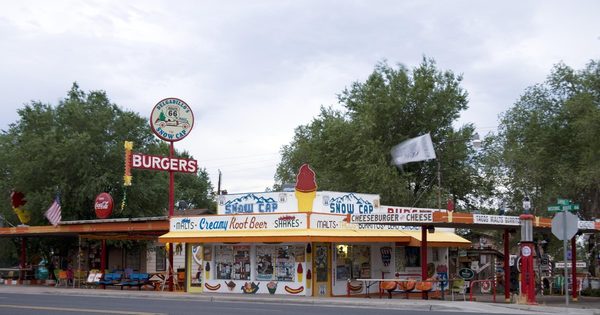
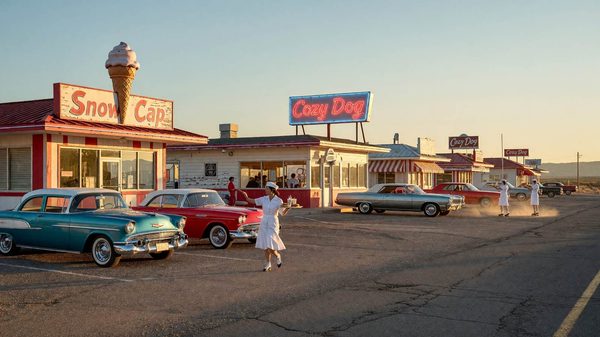
Delgadillo’s Snow Cap Drive-In is the non-negotiable stop — a seasonal, cash-preferred counter-service operation serving burgers, corn dogs, and soft-serve ice cream in the building that Juan Delgadillo built from salvaged lumber in 1953. The food is fine; the experience is singular. The Snow Cap’s deadpan humor, accumulated signage, and deliberate low-fi aesthetic make it the most photographed food stop on Arizona’s entire Route 66 stretch. For the full story and practical information, see our Snow Cap Drive-In guide.
The Roadkill Cafe is Seligman’s sit-down diner — conventional American diner food (burgers, breakfast plates, steaks) served in a historic building where the joke is entirely in the name. The food is what diner food is, and that is sufficient for a traveler who needs a real meal. More reliable hours than the Snow Cap, which is seasonally closed.
Westside Lilo’s Cafe operates on the western side of the commercial strip, serving breakfast and lunch. A smaller operation with a limited menu — useful for travelers coming through early in the morning when other options may not yet be open.
Williams: The Full-Service Gateway
Williams, about 28 miles east of Seligman via Interstate 40, is the nearest town to the South Rim of the Grand Canyon and has developed a full range of dining options oriented toward the substantial tourist traffic that combination generates.
The Rod’s Steak House on Route 66 in Williams is the most historically significant dining establishment in town — a western steakhouse that has been operating since 1946, with a distinctive neon-lit longhorn steer sign that is a landmark in its own right. Rod’s is a legitimate steakhouse, not a novelty stop, and is worth the visit for travelers who want a proper dinner after a day on the road.
The Williams commercial district on Route 66 also has pizza, Mexican food, and standard American diner options within a walkable stretch. For a town of roughly 3,000 people that serves as a Grand Canyon gateway, the dining variety is reasonable.
Flagstaff: The Largest City and the Longest Menu
Flagstaff at 7,000 feet elevation is a college town (Northern Arizona University) with a dining culture that reflects both its mountain-town character and its position on a major highway corridor. The Route 66 alignment through town runs along Historic Route 66 (formerly Santa Fe Avenue), and several establishments on this corridor are worth noting.
Miz Zip’s on Historic Route 66 is a long-running local diner that serves breakfast and lunch and has been a locals’ favorite for decades. Not famous in the Route 66 tourism sense, but a genuine working diner with regular customers who are not tourists.
Flagstaff has craft brewing, regional Mexican food from family operations with deep roots in the northern Arizona community, and the kind of breakfast-and-coffee culture that college towns generate. For travelers who have been eating at small-town diners for three days, Flagstaff offers a range that rewards spending a mealtime exploring.
Holbrook: Wigwam Village and Diner History
Holbrook sits east of Flagstaff on the Route 66 alignment and is known primarily for the Wigwam Motel (Wigwam Village No. 6) — a cluster of teepee-form concrete sleeping units from 1950 that is one of the most photographed roadside landmarks in the Southwest. The motel is operational; the diner that was part of the original Wigwam Motel complex is no longer.
Holbrook’s current dining is concentrated in a small commercial district that serves the traveling public with the standard range of highway diner options. The Joe & Aggie’s Cafe on Hopi Drive (a segment of the original Route 66 alignment) has operated for decades and represents the route’s diner tradition in an unpretentious form.
Kingman: The Western Terminus of the Classic Corridor
Kingman is the western end of the most intact Arizona Route 66 stretch and has a historic commercial district on Andy Devine Avenue (the Route 66 alignment through town) with several dining options worth noting.
Mr. D’z Route 66 Diner is probably the most Route 66-specific dining experience in Kingman — a 1950s-themed diner with vinyl booths, a soda fountain counter, and a menu of burgers, malts, and diner classics. It is a deliberate nostalgia project rather than a continuous family operation, which is a different kind of authenticity, but the food is good and the setting is appropriate to the drive you have just completed.
The Dambar & Steakhouse on Andy Devine Avenue has been a Kingman institution for decades and represents western steakhouse dining in the Arizona tradition — substantial portions, beef-forward menu, and the kind of local regular population that distinguishes a working local restaurant from a tourist operation.
Practical Considerations
Seasonal hours. Every food business on this corridor has some form of seasonal hour variation. Spring and fall (when Route 66 tourism peaks) have the most reliable hours. Summer has full-season operations at major stops. Winter reduces hours at most small operations and closes some entirely.
Cash. Cash is useful at any point on this corridor. Several businesses prefer cash, some require it, and many smaller stops have limited card processing capacity.
Timing. Arrive in Seligman before 3 PM if you want to experience the Snow Cap during operating hours. Do not arrive in Williams expecting dinner options at 10 PM — the town is a small town, not a city.
Fuel. Gas prices between the Interstate exits and the Route 66 commercial districts are typically higher than at freeway-exit stations. Fill up on the Interstate if cost matters.
Frequently Asked Questions
What is the best restaurant on Arizona’s Route 66?
The Snow Cap Drive-In in Seligman is the most singular food experience on the corridor — not because the food is the best, but because the experience is unreplicable. For a proper meal, Rod’s Steak House in Williams has operated since 1946 and represents the western steakhouse tradition with genuine longevity. The answer depends on what kind of eating experience you want.
Are there vegetarian or vegan options on Arizona’s Route 66?
The corridor’s diner and steakhouse tradition means that meat-free options are limited at most establishments. Flagstaff, as a college town, has the widest range of alternative dietary options. Bringing supplemental food for dietary-restricted travelers is practical for the Seligman-to-Kingman stretch specifically.
What should I eat at the Snow Cap Drive-In?
Burgers and soft-serve ice cream are the Snow Cap’s strengths. The corn dogs are also popular. The food is secondary to the experience — the humor, the accumulated character of the building, the way the transaction is conducted — which is itself the reason to stop.
Is there anywhere to get coffee along the Route 66 corridor?
Flagstaff has the most reliable coffee options, with independent coffee shops in the college-town tradition. Williams and Kingman each have coffee service at restaurants and at chain convenience operations near the Interstate interchanges. The stretch between Seligman and Kingman on the historic corridor is sparse for coffee — bring thermos.
Further Reading from Authoritative Sources
- Historic Route 66 Association of Arizona — Current business listings and visitor information for the Arizona Route 66 corridor, updated by the association Angel Delgadillo founded.
- National Park Service — Route 66 Food and Hospitality — NPS documentation of Route 66’s hospitality culture including the evolution of road-food establishments.