The drive-in restaurant was the perfect institution for Route 66. It combined automotive culture with food service in a form that required no intermediary — you drove in, you ate in the car if you wanted, and you drove out. The format emerged in the late 1920s and proliferated through the 1940s and 1950s, producing a density of drive-in operations along Route 66 that no other American highway could match.
Most are gone. The ones that survive have done so through some combination of local loyalty, regional fame, deliberate self-mythologizing, and the extraordinary luck of being in the right place when Route 66 tourism became a genuine economic phenomenon.
The Snow Cap Drive-In, Seligman, Arizona
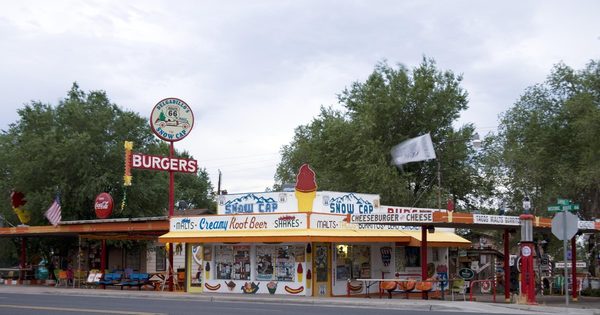
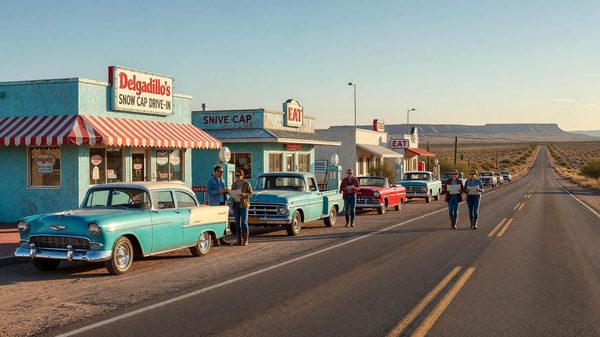
The Snow Cap is the most singular of the surviving Route 66 drive-ins — not necessarily the most famous, but the most irreplaceable. Juan Delgadillo built it in 1953 from salvaged lumber and corrugated metal in Seligman, Arizona, and operated it for fifty years with a deadpan humor that turned a small fast food operation into an experience that people specifically traveled to have.
The fake door that opens onto nothing. The condiment surprises. The “dead chicken” on the menu, delivered with a straight face. The handwritten signs that accumulate on every surface. Juan Delgadillo’s Snow Cap was performance art embedded in a burger stand, and its fame spread among Route 66 travelers in the analog era through word of mouth and the kind of collective memory that particularly unusual experiences generate.
Juan Delgadillo died in 2004. The family has continued to operate the Snow Cap, and the character he established has been maintained — the fake door is still there, the handwritten signs still accumulate, the humor is still part of the transaction. It is a faithful continuation rather than a faithful reproduction, because the Snow Cap under family operation since 2004 is a real thing, not a memorial.
The Snow Cap is seasonal — typically March through October, weather permitting — and cash-preferred. Its location in Seligman puts it at the center of the Route 66 preservation story, adjacent to Angel Delgadillo’s barbershop and within the Seligman Commercial Historic District. For the full guide to what the Snow Cap is and why it matters, see our complete Snow Cap Drive-In guide.
The Cozy Dog Drive-In, Springfield, Illinois
The Cozy Dog Drive-In in Springfield, Illinois has a specific claim that makes it significant beyond its age and its Route 66 position: its founder, Ed Waldmire Jr., is credited with developing the corn dog in its modern deep-fried-on-a-stick form in 1946.
This claim is disputed — multiple claimants exist for corn dog invention, and the history of food origin stories is predictably murky — but Waldmire did develop his “Cozy Dog” product (initially called the Crusty Cur) in the mid-1940s and begin selling it at the State Fair, then at his Springfield drive-in operation on Route 66.
The Cozy Dog Drive-In that exists today at 2935 South Sixth Street in Springfield is operated by the Waldmire family (third generation) and serves as both a working fast food establishment and a Route 66 roadside attraction. The interior has been developed as a collection of Route 66 memorabilia, including work by Bob Waldmire — Ed’s son, an artist whose detailed drawings of Route 66 life became influential in the Route 66 revival — who lived and traveled the route extensively in a converted bus.
The Cozy Dog Drive-In is worth a stop not just for the corn dogs (which are the menu’s legitimate draw) but for the family history it represents: multiple generations of a family whose identity is inseparable from the highway.
Dog n Suds, Various Surviving Locations
Dog n Suds was a drive-in chain founded in Champaign, Illinois in 1953 — the peak of the drive-in era. At its height, the chain had more than 600 locations, many of them on Route 66 and its Midwest successor highways. The chain’s root beer (served in frosted mugs, car-hop style) and hot dogs drove its menu identity.
Most Dog n Suds locations are gone. A handful of independently operated surviving franchisees continue to operate under the name in the Midwest. These are not chain operations — they are individual businesses that have maintained a brand affiliation longer than the corporate chain itself survived in any meaningful form.
For Route 66 travelers who encounter a surviving Dog n Suds (primarily in Illinois, Indiana, and Michigan), the experience is a genuine connection to the chain drive-in culture of the 1950s, preserved by the kind of local owner investment that chains usually eliminate.
Dairy Dip and Regional Soft-Serve Stands
Along the Route 66 corridor, the regional soft-serve stand — typically called a Dairy Dip, Dari Delight, or similar local variation — represents a drive-in format that the major chains (Dairy Queen, Tastee-Freez) eventually standardized without fully eliminating. The surviving independent soft-serve stands along Route 66 tend to be family operations that have been serving the same basic product since the 1950s or 1960s, with minimal change except the price.
These are not landmarks in the Snow Cap sense — they do not have the theatrical personality or the national fame. They are simply local businesses that have persisted through the decades because a small town still needs a place to get soft serve on a summer afternoon. Their value to the Route 66 traveler is the authenticity that comes from things that exist for their own reasons rather than for tourism.
What Was Lost
The catalog of what is gone from Route 66 drive-in culture is longer than what remains. The Mater’s Junkyard, the full-service car-hop operations of the 1950s where carhops on rollerskates brought food to your window — the elaborate version of the drive-in format largely disappeared in the 1970s and 1980s as McDonald’s and Burger King systematized fast food in ways that eliminated the individual personality that made the earlier drive-ins worth going to.
What survives does so precisely because it did not participate in that standardization. The Snow Cap in Seligman, the Cozy Dog in Springfield, the surviving regional one-offs — they are worth their fame because they represent a form of commerce that was designed around individual personality and local presence rather than brand consistency and replication.
Frequently Asked Questions
Is the Snow Cap Drive-In open year-round?
No. The Snow Cap operates seasonally, typically from March or April through October or November depending on weather. Specific hours and dates vary. Verify current status before planning your Seligman visit around a Snow Cap experience.
Did Route 66 invent the drive-in restaurant?
Route 66 did not invent the drive-in restaurant — the format developed in the late 1920s in Dallas, Texas and other cities before Route 66’s commercial development had fully formed. However, Route 66 was the commercial corridor along which drive-in culture reached its greatest density and diversity during its peak years (1940s-1960s), making the association between the highway and the format genuinely strong.
What happened to the drive-in restaurants on Route 66?
Most closed as a result of Interstate highway bypass (losing the through traffic that sustained them), changing consumer preferences (the drive-through format that McDonald’s popularized eliminated the carhop), and the economic contraction of bypassed towns. The survivors did so through local loyalty, deliberate self-preservation, and the Route 66 tourism revival that created a new customer base for places that had maintained their historical character.
Are there any car-hop style drive-ins still operating on Route 66?
Genuine carhop service — where food is brought to your car by a staff member, optionally on rollerskates — is extremely rare on Route 66. The drive-in format that survives is predominantly walk-up window service, not car-hop. The format most associated with carhops was largely eliminated by the drive-through model.
Further Reading from Authoritative Sources
- Smithsonian Magazine — The American Drive-In — Historical account of the drive-in restaurant’s emergence, peak, and partial survival in American food culture.
- National Park Service — Route 66 Food History — NPS documentation of Route 66 food culture including diners, drive-ins, and the commercial evolution of highway food service.