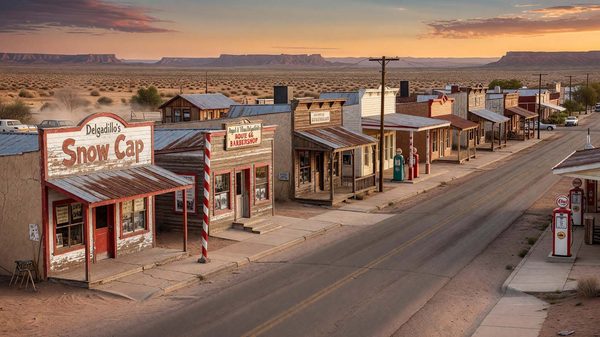
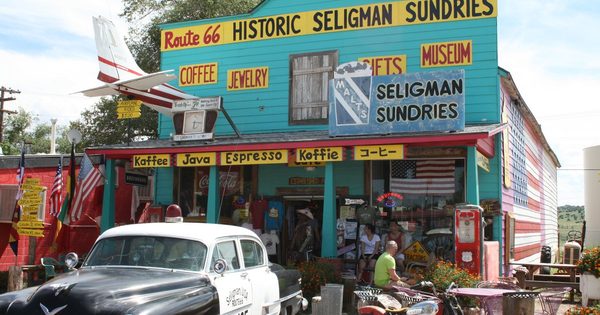
The Snow Cap Drive-In sits on the north side of Historic Route 66 in Seligman, Arizona, between a souvenir shop and a stretch of the commercial district that looks much as it did sixty years ago. It is small — maybe twenty feet wide — built from salvaged lumber and corrugated metal by Juan Delgadillo in 1953. It is covered in signs, hubcaps, painted plywood cutouts, and several decades’ worth of accumulated roadside curiosities. There is a fake door on the side of the building that does not open. There is a sign advertising “dead chicken.”
If you pull up expecting a normal fast food stop, you will be confused. If you arrive having done any reading about Route 66, you will recognize it immediately as one of the great institutions of the Mother Road.
Juan Delgadillo: The Man Behind the Stop
Juan Delgadillo was born in Seligman in 1921, the son of a family that had come from Mexico to work on the railroad. He grew up in a town that was both a railroad division point and a Route 66 community, and his sense of humor — dry, deadpan, relentless — was shaped by a lifetime of watching travelers pass through.
In 1953, Juan built the Snow Cap from lumber he salvaged from a demolished building. The construction was straightforward, the food simple: burgers, hot dogs, corn dogs, soft-serve ice cream. But Juan’s personality made the Snow Cap something different from a functional roadside stand.
His signature move was the fake door. He installed a door-shaped frame on the side of the Snow Cap that appeared to be a normal entrance but, when visitors reached for it, simply swung open on hinges to reveal nothing behind it. The look on people’s faces when they reached for the nonexistent handle apparently never got old for Juan.
Other bits of business followed: he would offer customers mustard and then squirt it at them from a concealed bottle. He would deadpan-upsell “dead chicken” with complete seriousness. He developed a catalog of pranks, non-sequiturs, and running jokes that became as much a part of the Snow Cap experience as the food itself.
The result was a stop that travelers talked about long after they had forgotten the name of every other restaurant they visited on their Route 66 trip.
The Architecture
The Snow Cap is not architecturally sophisticated, and that is part of the point. Juan built it himself, from salvaged materials, with the resourcefulness that Route 66 roadside entrepreneurs necessarily developed during the mid-century era. The building has been modified and expanded over the decades but retains the essential character of its original construction.
The accumulation of signs, artifacts, and decorative objects on the exterior of the Snow Cap represents a kind of outsider art. Each object was placed deliberately — or was the product of a spontaneous joke — but the overall effect is of a building that has been continuously inscribed with personality over seventy-plus years. There is something similar to what scholars of vernacular architecture call “decorated shed” — a functional structure whose identity is carried almost entirely by its applied ornament rather than its form — but the Snow Cap’s decoration is more personal and more eccentric than most examples of the type.
Food writers and travel journalists who have covered the Snow Cap over the years — including coverage by Eater and regional publications across the Southwest — have consistently noted that the building’s visual character is inseparable from its cultural significance. You cannot describe the Snow Cap without describing how it looks.
The Menu
The Snow Cap’s menu has been consistent across its decades of operation: burgers, cheeseburgers, hot dogs, corn dogs, and soft-serve ice cream are the core. The “dead chicken” is, disappointingly or delightfully, a chicken sandwich or chicken strip depending on current availability. There are soft drinks, shakes, and the kind of simple sides that belong to the roadside drive-in tradition.
The food is good — this is not a “famous despite bad food” situation — but it is not elaborate. The burgers are fresh-pressed, the ice cream is real soft-serve, and the hot dogs are exactly what you want from a drive-in on a hot Arizona afternoon. The Snow Cap is not trying to be a destination restaurant. It has always been a roadside stop, and it succeeds entirely as one.
Prices have crept up over the years — as they have everywhere — but the Snow Cap remains on the affordable end of the spectrum. A burger, side, and a cone will typically run under $15.
Cash and Operational Realities
The Snow Cap prefers cash. Bring it. An ATM is available nearby but operating in cash-first mode at the Snow Cap is both more reliable and more in keeping with the spirit of the place.
The Snow Cap is seasonal. It typically operates from approximately March through October, but exact opening and closing dates vary with weather, family schedules, and operational considerations. The Snow Cap has also had periods of closure for maintenance and renovation. Do not build your entire Route 66 itinerary around a guaranteed Snow Cap visit without verifying current hours.
When it is open, hours are generally late morning through late afternoon — think of it as a lunch and early dinner stop rather than a breakfast destination. Weekend hours during peak season tend to be more reliable than weekday hours.
After Juan: The Family Continues
Juan Delgadillo passed away in September 2004. He was 83. His death was marked by Route 66 enthusiasts across the world; he had become, like his brother Angel, an icon of the Mother Road and its culture.
The Snow Cap has continued under family operation. The humor, the fake door, and the accumulated artifacts remain — the place is both a tribute to Juan and a continuing business. The family has navigated the balance between preservation and operation with what appears to be sincere commitment to keeping the Snow Cap’s character intact.
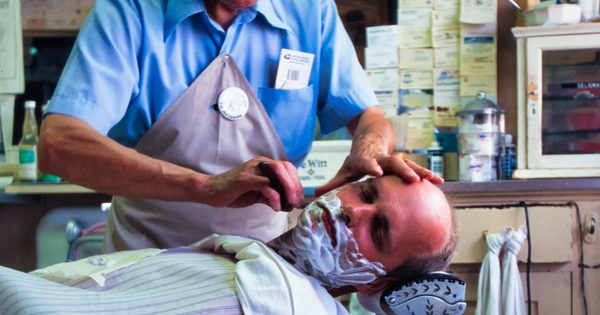
Juan’s brother Angel Delgadillo — the barber and preservation activist who organized the 1987 meeting that saved Route 66 — continues to operate his barbershop a few blocks away. Together, the Delgadillo family’s contributions to Seligman’s identity are central to understanding why the town matters. Read our full piece on Angel Delgadillo.
The Snow Cap in the Context of Route 66 Food Culture
The Snow Cap belongs to a tradition of roadside food culture that Route 66 developed and sustained from its commissioning in 1926 through the bypass era of the 1970s. The drive-in format — ordering at a window, eating outdoors or in your car — was native to highway culture. It suited the pace and character of road travel in a way that sit-down restaurants often did not.
Many Route 66 drive-ins did not survive the bypass era. Their economics depended on the traffic the highway produced, and when the traffic moved to the Interstate, the businesses often followed — or closed. The Snow Cap’s survival is partly a product of Seligman’s particular Route 66 character, the preservation movement that Angel Delgadillo initiated, and the tourism economy that grew from it.
It is also a product of Juan’s personality. The Snow Cap was never interchangeable with any other roadside stand because Juan made it irreplaceably his. That identity has outlasted him and continues to draw visitors who have read about him, watched documentaries featuring him, or arrived chasing the town’s connection to Pixar’s Cars and the fictional Radiator Springs — a film whose roadside spirit owes a real debt to places exactly like the Snow Cap.
For visitors coming from Flagstaff or Williams heading west, the Snow Cap is one of the first stops you encounter in Seligman. Consider it both a meal and an introduction to the Route 66 sensibility that the town embodies. Read our complete guide to Seligman for everything else you should see while you are there.
Frequently Asked Questions
Is the Snow Cap Drive-In open year-round?
No. The Snow Cap operates seasonally, typically from spring through fall. Exact dates vary; the business has closed for extended periods during off-season and for maintenance. Verify current hours before planning your visit around the Snow Cap.
Did Juan Delgadillo really squirt mustard at customers?
Yes, this is well-documented in multiple accounts from Route 66 writers and travelers. The mustard squirt — typically delivered when a customer asked for condiments — was one of Juan’s signature bits. Whether the current operation maintains all of his specific routines is less certain, but the spirit of the place is preserved.
Is the fake door still there?
As of recent visits, the fake door remains a feature of the Snow Cap exterior. It is located on the side of the building and continues to confuse first-time visitors exactly as Juan intended.
What is the best thing to order at the Snow Cap?
The burger and a soft-serve cone is the canonical Snow Cap meal. The ice cream is good — it is real soft-serve, not a commercial brand product — and the burger is fresh. If you are there in warm weather, eating outside with a view of Route 66 is the full experience.
Hero image: “Snow cap burger cafe, Route 66, Seligman, Arizona” by Carol M. Highsmith, part of the Carol M. Highsmith Archive, Library of Congress (no known restrictions on publication).