In February 1987, Angel Delgadillo invited his neighbors to a meeting at the Copper Cart restaurant in Seligman, Arizona. He had been watching his town die for nine years — ever since Interstate 40 had bypassed Route 66 in 1978 and taken the traffic that sustained the community’s businesses and livelihoods. He had an idea, and he wanted to know if anyone else would join him.
Sixty people showed up. That meeting produced the Historic Route 66 Association of Arizona, and the movement that grew from it eventually saved what remained of America’s most famous highway.
Angel Delgadillo’s story is inseparable from the story of Route 66 itself.
The World Angel Grew Up In
Angel Delgadillo was born in Seligman in 1927, the son of a family that had come to Arizona from Mexico. Seligman at that time was a functioning railroad and highway town. The Atchison, Topeka and Santa Fe Railway maintained a division point there, which meant the town had a population large enough to support a full commercial district: hotels, restaurants, service stations, a Harvey House, and the kinds of small businesses that catered to both railroad workers and highway travelers.
When U.S. Route 66 was commissioned in 1926 and subsequently paved and improved through the 1930s, Seligman’s position on the highway amplified its commercial life. The road brought a second stream of customers — tourists, migrants, truckers — layered on top of the railroad economy. The town was small but viable, sustained by the traffic that passed through it.
Angel became a barber in this world. He opened his barbershop in downtown Seligman in 1950, and for the next three decades he cut the hair of locals, railroad workers, and travelers while watching the economic fabric of his community fray and eventually tear.
The Bypass and Its Consequences
The opening of Interstate 40 through the Seligman area in 1978 was the culmination of a process that had been underway for more than a decade. The Interstate Highway System, authorized by the Federal Aid Highway Act of 1956, was designed to move traffic efficiently and safely — purposes that left the two-lane, stop-filled Route 66 behind. One by one, the communities along the old highway were bypassed.
For Seligman, the 1978 bypass was catastrophic. The through traffic that had sustained its businesses evaporated almost immediately. Gas stations and motels that had operated for decades closed within months. The population began to decline. Businesses that served travelers had no customers; businesses that served locals found the local economy contracting as employment shrank.
Angel watched this happen from his barbershop. He continued to operate — there were still local people who needed haircuts — but the commercial district around him hollowed out. Buildings that had been active businesses stood empty. The neon signs went dark. The motels posted “closed” signs that never came down.
The National Park Service’s Route 66 documentation describes this pattern repeating across the length of the highway: a chain of bypassed communities losing population, commerce, and eventually hope.
The 1987 Meeting
What moved Angel to act in 1987 was, in part, the example of Illinois. The Illinois Route 66 Association had organized earlier, and word had reached Arizona that it was possible to treat the old highway not as a relic to be mourned but as a cultural resource to be mobilized. If people who remembered Route 66 — or who had never seen it but had heard of it — could be persuaded to seek it out, the communities along it might find a new economic identity as destinations rather than stopovers.
Angel believed Seligman could be part of that story. But he also understood that individual towns could not do much alone. What was needed was an organization that could advocate for the whole Arizona corridor, seek historical designation for significant sites, lobby for signage and infrastructure improvements, and — critically — generate the publicity that would bring travelers off the Interstate and back onto the old road.
The February 1987 meeting at the Copper Cart produced that organization. The Historic Route 66 Association of Arizona was founded that evening, with Angel as its first president. Copies of the founding meeting’s resolutions were sent to every governor whose state contained a portion of the historic highway.
The response, eventually, was the formation of similar associations in every Route 66 state — and ultimately the creation of a national coordinating body, the National Historic Route 66 Federation, which works with federal agencies, state DOTs, and local organizations to preserve and promote the highway.
The Barbershop as Pilgrimage Site
Something unexpected happened after the association’s founding. Travelers began coming to Seligman specifically to see the town — and specifically to meet Angel Delgadillo. His story had spread through the Route 66 community, and his barbershop became a pilgrimage site.
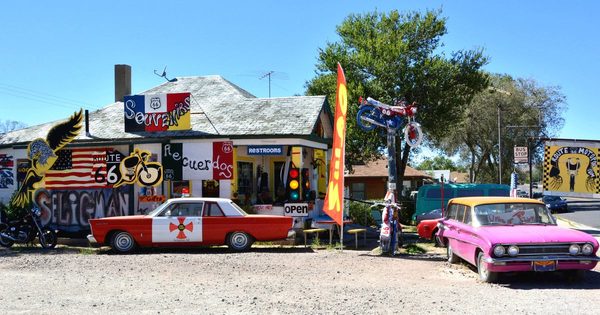
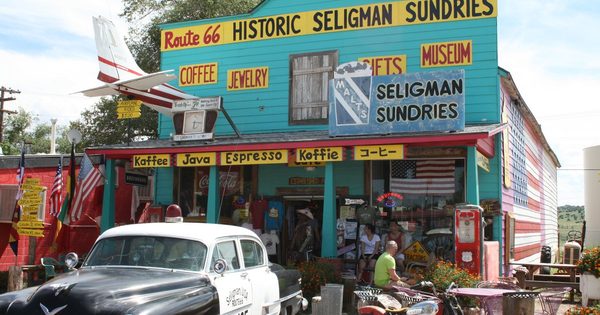
Angel’s shop is on the north side of Route 66 in downtown Seligman, recognizable by the signs and memorabilia accumulated over decades of operation. It is a working barbershop — Angel continued to cut hair well into his eighties — but it is also an informal museum and welcome center. Angel signs memorabilia, poses for photographs, and tells the story of the road and the town to visitors who have come from Japan, Germany, Australia, and dozens of other countries to meet the man who saved Route 66.
This phenomenon — the transformation of a working barber into an international icon of Americana — says something important about what Route 66 means in the cultural imagination. The highway has become a symbol of a particular vision of America: democratic, mobile, inclusive, connected to the land and the landscape rather than the abstract systems of finance and technology. Angel Delgadillo, who stayed in his small town when the traffic left and organized his neighbors when the situation seemed hopeless, embodies that vision in a way that resonates across cultures.
Juan Delgadillo and the Snow Cap
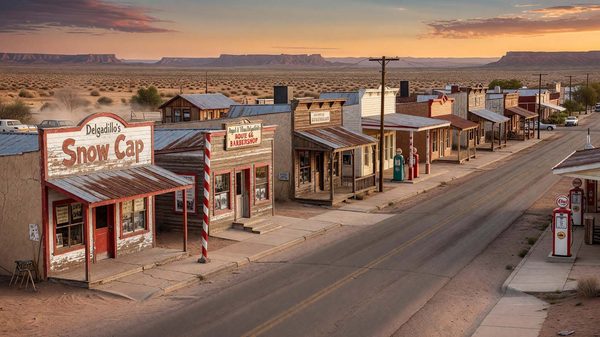
Angel’s brother Juan was equally central to Seligman’s Route 66 identity, though in a very different register. While Angel operated a dignified barbershop and became the statesman of the preservation movement, Juan built the Snow Cap Drive-In in 1953 from salvaged lumber and corrugated metal, covered it in signs and hubcaps and decade-old jokes, and operated it as one of the most eccentric and beloved roadside institutions on the entire highway.
Juan’s humor was deadpan and relentless. He installed a fake second door on the Snow Cap that wouldn’t open. He offered customers “dead chicken” (a menu staple) with a straight face. He squirted mustard at visitors who weren’t paying attention. The Snow Cap was both a real business and a performance piece, and Juan’s persona was inseparable from the experience of eating there.
Juan passed away in 2004. The Snow Cap has continued under family operation. Read our full coverage of the Snow Cap Drive-In — it remains one of the essential stops on any visit to Seligman.
The Broader Legacy
The preservation movement that Angel’s 1987 meeting initiated has had consequences that extend well beyond Seligman. The Route 66 corridor is now one of the most studied examples of heritage tourism development in the United States. The economic model — converting a bypassed transportation corridor into a destination by emphasizing its historical and cultural character — has been applied to other historic routes and rail corridors across the country.
The formal preservation framework followed the organizational groundwork. Route 66 was designated an All-American Road under the National Scenic Byways Program. The Route 66 Corridor Preservation Program, administered by the National Park Service, has funded the preservation of hundreds of significant properties along the highway. Individual communities have pursued National Register listings for their commercial districts, as Seligman did for the Seligman Commercial Historic District.
The Historic Route 66 Association of Arizona — Angel’s original organization — continues to operate from Seligman and remains one of the most active Route 66 preservation bodies in the country. For the broader history of Seligman across all three of its economic eras, see our complete history of Seligman, Arizona.
The Pixar Connection
In 2006, Pixar released Cars, an animated feature whose fictional town of Radiator Springs was drawn significantly from Seligman and other Route 66 communities. The film’s central narrative — a bypassed town struggling to survive after the Interstate took its traffic, finding renewal through travelers who rediscover the old road — was a version of Seligman’s own story. Angel Delgadillo was personally consulted by the Pixar production team during development.
The film’s release produced a surge of visitors to Seligman, many of whom had no prior knowledge of Route 66 history but recognized the town from the movie. For a new generation of travelers, Seligman’s story arrived through animation before it arrived through history. Read the full story of Seligman and the Cars connection.
Frequently Asked Questions
Where is Angel Delgadillo today?
Angel Delgadillo, born 1927 in Seligman, operated his barbershop from 1950 onward and was the central figure in the Route 66 preservation movement for decades following the 1987 founding meeting. For current information about Angel, his barbershop, and visitor availability, contact the Historic Route 66 Association of Arizona.
Where is Angel Delgadillo’s barbershop?
The Delgadillo Barbershop is located at 22265 Historic Route 66 in Seligman, Arizona, on the north side of the road in the downtown commercial district. It is well-signed and easily found — look for the memorabilia and signs.
What happened to the Historic Route 66 Association of Arizona after Angel founded it?
The association grew from a single Arizona organization to become part of a national network of Route 66 preservation bodies. It continues to operate from Seligman, organizing events, advocating for preservation, and welcoming visitors. Its signature event is the Route 66 Fun Run from Seligman to Topock each spring — the oldest Route 66 celebration in the country, and a direct descendant of the movement Angel began.
Did the bypass of Route 66 affect all towns equally?
No. Towns very close to Interstate interchanges were often able to capture some of the replacement traffic. Towns that were bypassed entirely — like Seligman, which sits between the Ash Fork and Kingman exits on I-40 — bore the full economic impact. The communities that suffered most were also, paradoxically, the ones that retained the most authentic Route 66 character because redevelopment never occurred.
Hero image: “Angel Delgadillo, the founder of the Historic Route 66 Association of Arizona, at work in his barber shop in Seligman” by Zeddammer, CC BY-SA 4.0, via Wikimedia Commons (cropped).
.jpg)