Before Route 66 existed, before the modern highway system that Route 66 would eventually become, the American Southwest was served by the Atchison, Topeka and Santa Fe Railway and by a remarkable hospitality enterprise that the railway’s success made possible. The Fred Harvey Company — an organization that combined restaurant service, hotel accommodations, and gift retail across the Santa Fe system — defined the experience of the Southwest for an entire generation of American travelers. It also, in ways that are easy to overlook, shaped the corridor that would become Route 66.
Fred Harvey and the Problem with Railroad Food
Frederick Henry Harvey was born in London in 1835 and immigrated to the United States as a young man. By his early thirties he had worked in restaurant and hotel operations in various American cities and become deeply familiar with the state of railroad food service in the post-Civil War era.
That state was dismal. Passenger trains stopped at depot eating houses for twenty minutes, during which travelers were served food of reliable badness at prices that guaranteed it: greasy, cold, poorly prepared, expensively priced, served by staff with no reason to care about quality or customer satisfaction. Travelers frequently went hungry rather than submit to the alternative.
Harvey approached the Santa Fe Railway in 1876 with a proposal: he would operate a chain of restaurant and hotel facilities at depots along the Santa Fe line, guaranteeing quality that the railway’s reputation could safely attach itself to. The railway provided the space; Harvey provided the operation. The partnership began with a restaurant in Topeka, Kansas.
The success was rapid and complete. By the time of Harvey’s death in 1901, the Harvey Company operated fifteen hotels, forty-seven restaurants, and thirty dining cars across the Santa Fe system. His son Ford Harvey expanded the operation through the 1920s and 1930s, adding the Southwestern regional architecture and Native American craft merchandising that came to define the Harvey Company’s cultural identity.
The Harvey Houses Along the Corridor
The Harvey Houses — the hotels and restaurants at Santa Fe Railway depots — occupied several locations directly on or immediately adjacent to what would become Route 66. Seligman had a Harvey House (the former Harvey House building remains part of the historic district fabric). Winslow, Flagstaff, and Gallup had Harvey House operations, as did Albuquerque’s La Posada (which survives as a restored hotel today).
These were not simple diners. The Harvey houses at major stops were full-service hotels with formal dining rooms, attentive service, regionally sourced ingredients where possible, and architecture that the Harvey Company took seriously as both guest experience and brand statement. Mary Colter, the Santa Fe Railway’s longtime architect and designer, created Harvey House facilities that were design statements engaging with Pueblo and Spanish Colonial architectural traditions — including La Posada in Winslow and Bright Angel Lodge at the Grand Canyon’s South Rim.
The Albuquerque Harvey House (the Alvarado Hotel, demolished in 1970) is frequently cited as the most significant loss of historic Southwest railroad hotel architecture. Its destruction was part of the urban renewal clearance that affected many cities in the 1960s. La Posada in Winslow, once slated for a similar fate, was eventually restored and is now a functioning hotel and a legitimate heritage destination.
The Harvey Girls
The Fred Harvey Company’s food and service quality depended on a specific labor force: the Harvey Girls. Harvey recruited young women — primarily from the Midwest — to staff the dining rooms at Harvey House locations, providing trained, professional service in environments where no comparable tradition of professional restaurant service existed.
The Harvey Girl recruitment was systematic: advertisements in Midwestern newspapers, training programs at established Harvey locations, housing in Harvey-owned dormitories adjacent to the restaurants, and strict standards of conduct and appearance. The positions were genuinely prestigious — offering wages, housing, and working conditions that were superior to most alternatives available to unmarried women in late-19th-century America.
The Harvey Girls became a significant cultural phenomenon. They brought a standard of hospitality to frontier railroad towns that shaped those towns’ development, and they married into the communities along the Santa Fe line at a rate that made the Harvey system a significant driver of demographic change across the Southwest. Harvey himself is quoted as estimating that the Harvey Girls had “civilized the West.”
The Smithsonian Institution’s National Museum of American History has documented the Harvey Girl phenomenon as a significant chapter in the history of women’s labor in America, part of a broader expansion of professional service roles for women in the late 19th and early 20th centuries.
The Harvey Company and Native American Culture
One of the Fred Harvey Company’s most complex legacies is its role in shaping American consumer engagement with Native American craft traditions. The Harvey Company became, from around 1900 onward, the primary conduit through which Navajo, Hopi, Pueblo, and other Southwest Native American crafts reached a national market.
Harvey established curio shops — the “Indian Building” attached to the Albuquerque Alvarado being the most significant — where authentic Native crafts were sold to railroad travelers. Herman Schweizer, the Harvey Company’s chief Indian Department buyer, developed relationships with Native craftspeople across the region, commissioning work and purchasing inventory in ways that both sustained traditional craft production and shaped it toward tourist market preferences.
This relationship has been examined critically by historians of Native American culture: the Harvey Company’s role in “authenticity” standards and market shaping affected what forms of Native craft were produced and valued. At the same time, the market access provided by Harvey distribution was economically significant for Native communities in a period when other economic options were severely constrained.
The gift shops at Harvey House locations — including Seligman’s — were early venues for this commerce, establishing the sale of Native American crafts as a standard element of Route 66 commercial culture that persists in various forms today.
The Harvey Company’s Relationship to Route 66
Route 66 was commissioned in 1926. The Santa Fe Railway’s Harvey Houses had been operating along this corridor for nearly fifty years by that point. The highway, in significant measure, followed the existing economic geography of the railway — the towns with Harvey Houses and Santa Fe depots became the towns that Route 66 passed through.
The result was a layered infrastructure of hospitality: the railway and Harvey Houses serving long-distance passenger traffic, the highway serving automotive travelers who needed fuel, food, and accommodation at highway pace. The Harvey Company eventually adapted to highway travel by operating services oriented toward auto tourists in addition to rail passengers.
The Fred Harvey Company was eventually acquired by Amfac Resorts in 1968 after the decline of long-distance passenger rail travel made the railroad-dependent model non-viable. The Grand Canyon’s South Rim operations continued under the Harvey name for decades, and the Xanterra Parks and Resorts company that acquired them maintains several historic Grand Canyon properties that the Harvey Company established.
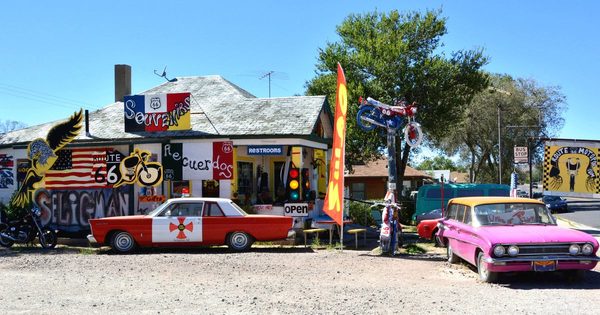
In Seligman, the relationship between the Santa Fe Railway and the town’s economic development is inseparable from the Route 66 story. The railway provided the town’s initial reason for existing; Route 66 provided its second economic era; the preservation movement that Angel Delgadillo launched is its third. Read more about Seligman’s historic commercial district and how these layers of economic history are visible in the buildings that remain.
Frequently Asked Questions
What is a Harvey House?
A Harvey House is a restaurant, hotel, or combination of both operated by the Fred Harvey Company at or near a Santa Fe Railway depot. Harvey Houses were established along the Santa Fe system beginning in the 1870s, providing food and accommodation that was dramatically better than the railroad station eating houses they replaced. By the early 20th century, the Harvey House network extended from Kansas City to Los Angeles along the Santa Fe route.
What happened to the Harvey Houses?
Most Harvey Houses were demolished as railroad passenger traffic declined after World War II. A few have been preserved and repurposed — La Posada in Winslow, Arizona is the most complete surviving Harvey hotel and is now operated as a hotel and restaurant. The Castañeda in Las Vegas, New Mexico was restored and reopened as a hotel in 2019. The Albuquerque Alvarado Hotel was demolished in 1970 despite preservation efforts.
Who were the Harvey Girls?
Harvey Girls were the young women hired by the Fred Harvey Company to staff Harvey House dining rooms. Recruited primarily from the Midwest, they were trained to professional service standards, housed in Harvey-provided dormitories, and compensated comparably to other professional roles available to women in the late 19th and early 20th centuries. Their presence transformed the service culture of Southwest railroad towns.
Where can I visit a surviving Harvey House today?
La Posada Hotel in Winslow, Arizona (designed by Mary Colter, restored and operating since 1997) is the most significant surviving Harvey House. The Castañeda Hotel in Las Vegas, New Mexico reopened in 2019 after an extensive restoration. The Grand Canyon’s Bright Angel Lodge (also Colter-designed) retains its Harvey Company heritage despite Amfac and Xanterra ownership.
Further Reading from Authoritative Sources
- Smithsonian Magazine — Fred Harvey and the Harvey Girls — Historical account of Fred Harvey’s hospitality enterprise and the Harvey Girls’ cultural significance.
- National Park Service — La Posada and Mary Colter’s Legacy — Route 66 stories including coverage of Harvey House architecture and Mary Colter’s design influence along the corridor.
Hero image: “La Posada Hotel, Winslow, Arizona” by Flickr user dvs, CC BY 2.0, via Wikimedia Commons (cropped).
.jpg)