The American roadside has always been a medium for expression that galleries did not accommodate — too large, too site-specific, too deeply embedded in the experience of passing through rather than stopping intentionally. Route 66, with its decades of commercial buildup and its equally dramatic commercial collapse, became the occasion for an unusual concentration of this tradition. Some of it was commerce dressed as spectacle. Some of it was folk art in the truest sense: made by private individuals with private resources for the pleasure of making it.
The result is a corridor that functions as a kind of distributed gallery — dispersed across more than 2,000 miles, requiring a car to experience it, and rewarding those who actually make the drive with encounters that no reproduction can adequately prepare you for.
The Commercial Spectacle Tradition
The origins of Route 66 roadside art are commercial. Early highway businesses competed fiercely for traveler attention in an era when travelers had no information source beyond what they could see from the road. The sign, the giant object, the painted wall — these were advertising in an environment where advertising had to work at highway speed and from a distance.
Meramec Caverns in Missouri famously plastered barn roofs across the Midwest with its name, a practice that reached hundreds of structures along Route 66 and well beyond. The barn roof paintings are a folk art tradition in themselves, and several remain visible from the road today — weathered to near-illegibility in some cases but still present.
The giant roadside object — a dinosaur, a coffee pot, a chicken — was the more three-dimensional form of the same commercial impulse. These objects functioned as landmarks and advertising simultaneously, trading on the visual novelty that a seventy-foot-tall dinosaur provides for a traveler who has been staring at flat Oklahoma landscape for three hours. Most have been lost. A few survive. The ones that survive have often outlasted the businesses they were built to advertise.
Cadillac Ranch: The Exception That Defines the Category
Cadillac Ranch outside Amarillo, Texas occupies a special position in the history of American roadside art because it was conceived from the beginning as art rather than commerce, installed in 1974 by the artists’ collective Ant Farm with patronage from Amarillo eccentric Stanley Marsh 3.
Ten Cadillacs, from a 1949 Club Coupe to a 1963 Sedan de Ville, are buried nose-first in a field adjacent to the old Route 66 alignment at an angle that approximately replicates the inclination of the Great Pyramid of Giza. The cars are painted — continuously, by visitors who are encouraged to add spray paint — and have been repainted wholesale at various points in the installation’s history.
The critical conceptual element of Cadillac Ranch is that it is not static. The continuous addition of visitor paint makes it a collective ongoing project rather than a finished work. The cars have been buried, relocated once (when the city expanded and urban development reached the original site), and adapted over decades while maintaining the core installation’s identity.
The installation’s engagement with Route 66 is deliberate: the Cadillac model years span the golden era of American automotive culture and Route 66’s commercial peak. The burial is both tribute and elegy — the cars are there, monumental, but underground. Cadillac Ranch is accessible from the I-40 Business Route (the former Route 66 alignment) east of Amarillo, on private land that is open to public access.
The Blue Whale of Catoosa
In 1972, Hugh Davis built a concrete whale in a pond on his property in Catoosa, Oklahoma, as a gift to his wife Zelta. The whale — a two-story-high sculpture of a blue whale sitting on a berm at the edge of a spring-fed pond — was intended to be a private anniversary present. It became a public attraction almost immediately.
The Blue Whale served as a swimming hole throughout the 1970s and into the 1980s, with families stopping to swim in the pond under the whale’s benevolent profile. After Hugh Davis died in 1990, the property fell into disrepair and the swimming area closed. A community restoration effort in 2010-2013 stabilized the whale and restored public access to the site as a viewable landmark.
The Blue Whale is one of the purest examples of what Route 66 roadside art at its best accomplished: a personal expression, made without commercial intent or artistic training, that became a landmark through the simple power of its strangeness and its evident good humor. The whale is not trying to be anything other than what it is — a concrete whale in a pond — and that directness has given it a longevity that more calculated attractions have not achieved.
The Murals of Tucumcari
Tucumcari, New Mexico developed a mural program beginning in the late 1990s as part of a broader effort to revitalize the historic downtown commercial district. The result is a concentration of outdoor murals depicting Route 66 history, local New Mexico culture, and the Tucumcari area’s specific history that makes the town one of the best walking-tour mural destinations on the entire highway.
The murals range from straightforward historical documentation — paintings of historic buildings, transportation vehicles, and Route 66 scenes — to more interpretive works that engage with Tucumcari’s position in the American Southwest. Several are large enough to cover entire building facades and are best viewed from across the street or from the road.
The Tucumcari mural program represents a replication, in more organized form, of the individual commissioned murals that have appeared on commercial buildings throughout the Route 66 corridor as communities used painted facades as a form of place-making and heritage marketing.
Seligman’s Contribution: The Living Museum
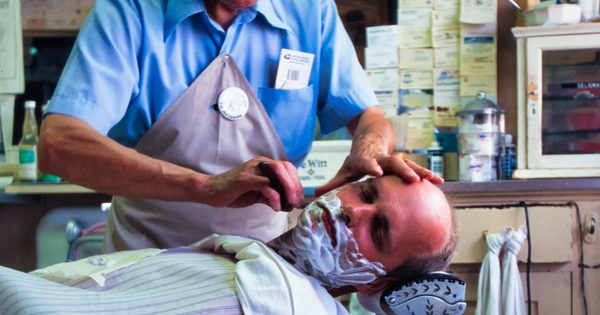
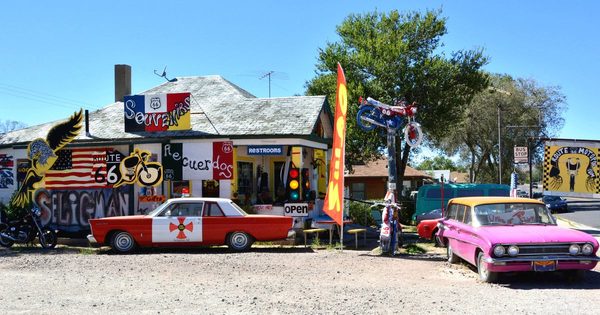
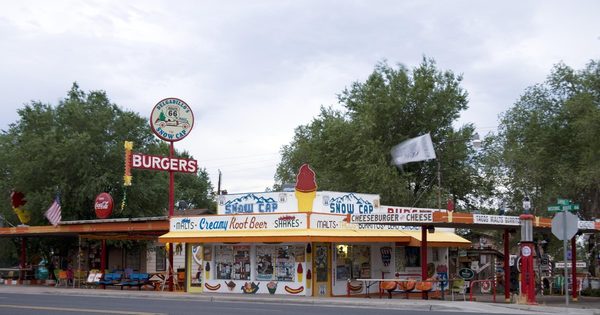
Seligman’s approach to Route 66 visual culture is different from Cadillac Ranch or Tucumcari’s mural program. Rather than organized art installations or a programmatic mural effort, Seligman’s visual landscape has accumulated organically — signs added to the exterior of the barbershop, merchandise displayed outside shops, the Snow Cap’s accumulation of decades of signage and found objects.
The result is harder to document as “art” but may be more authentically expressive of the Route 66 commercial visual tradition. The Snow Cap Drive-In specifically — with its hand-lettered signs, its hubcap collections, its general rejection of graphic professionalism in favor of personal expression — represents a style of commercial signage that the national fast-food chains systematically eliminated from the American roadside after 1960. On Route 66, the independent operators who survived the bypass found customers who valued exactly this kind of individual expression.
The Seligman Commercial Historic District preserves the architectural context within which this visual culture exists, ensuring that the setting remains continuous with the signs.
Contemporary Route 66 Murals
The Route 66 mural tradition continues to grow. Communities along the corridor that once had only vintage commercial signage now have contemporary murals commissioned from professional artists — some documenting local history, some engaging with Route 66’s cultural legacy, some simply providing visual anchor points for tourist photographs.
This contemporary layer sits on top of the original accumulation rather than replacing it, creating a visual palimpsest that rewards the traveler who pays attention to dates and contexts. A 1950s commercial sign, a 1970s folk art installation, and a 2015 professional mural may occupy the same view frame in a Route 66 town — each a product of a specific moment in the highway’s history.
Frequently Asked Questions
What is the most famous piece of Route 66 roadside art?
Cadillac Ranch outside Amarillo, Texas is probably the most internationally recognized Route 66 art installation. The Blue Whale of Catoosa in Oklahoma is a close contender for most beloved. Both are accessible to the public and worth a stop on a full Route 66 drive.
Can I add paint to Cadillac Ranch?
Yes. Visitors are encouraged to spray paint the Cadillac Ranch cars — bring your own spray paint. The installation’s identity depends on this participation. The cans discarded on-site are themselves part of the accumulated visual record.
Are there murals in Seligman?
Seligman’s visual landscape is more accumulative than mural-specific — the commercial signage and decorative accumulation on buildings like the Snow Cap and the barbershop are the town’s visual character. Individual hand-painted signs exist throughout the commercial district. For organized mural programs, Tucumcari is the most concentrated destination on the corridor.
Where can I see the best Route 66 neon signs?
Tucumcari, New Mexico has the highest surviving concentration of vintage neon signs in a single walkable area. The Blue Swallow Motel’s sign is among the most photographed. Galena, Kansas; Miami, Oklahoma; and Williams, Arizona each have surviving neon installations worth seeing.
Further Reading from Authoritative Sources
- Smithsonian Magazine — Route 66 Visual Culture — Historical overview including the commercial art traditions that defined Route 66’s visual character.
- National Park Service — Route 66 Cultural Landscape — NPS documentation of Route 66’s cultural heritage including signage, commercial art, and the preservation of highway visual culture.