When the National Register of Historic Places listed the Seligman Commercial Historic District, it did more than acknowledge a cluster of old buildings on a two-lane Arizona highway. It recognized something rarer: a community that had survived the economic violence of being bypassed by an Interstate, held itself together through decades of quiet determination, and eventually became the unlikely catalyst for one of America’s great preservation movements.
Understanding what the historic district designation covers — and what it doesn’t — helps explain why Seligman looks and feels the way it does today.
What Is the Seligman Commercial Historic District?
The Seligman Commercial Historic District encompasses the core commercial blocks of downtown Seligman along what was once U.S. Route 66, now signed as Historic Route 66 through town. The district captures the built fabric of a highway commercial strip from roughly the 1920s through the 1960s — the period when Route 66 was a functioning artery connecting Chicago to Los Angeles, and Seligman was a significant stop along it.
The buildings within the district represent the full range of services that Route 66 travelers once required: tourist courts, filling stations, diners, general merchandise stores, and the facilities that served both highway travelers and the railroad community that Seligman had been for decades before the highway era.
For more context on historic Route 66 preservation designations, the National Park Service’s Route 66 Corridor Preservation Program provides the federal framework under which many of these listings have been pursued.
The Architectural Character
The commercial buildings of Seligman share the characteristic vernacular architecture of the American highway strip from the mid-twentieth century. This is not the monumental architecture of a courthouse square — it is the utilitarian, often improvised commercial architecture of a town that grew to serve travelers and railroad workers, not civic ambition.
What makes it distinctive is its relative integrity. Many Route 66 commercial districts were demolished during the urban renewal era or replaced during the suburban boom. Seligman’s commercial core survived, in significant part, because the economic depression that followed the 1978 Interstate bypass meant there was little incentive — or capital — for redevelopment.
Adversity preserved what prosperity might have destroyed.
The buildings reflect several distinct eras:
The Railroad Era — Seligman was established as a railroad division point on the Atlantic and Pacific Railroad (later the Atchison, Topeka and Santa Fe Railway) in 1886, and several of the oldest surviving structures date from this period or the early highway era. The Harvey House presence in Seligman was part of the broader Fred Harvey Company network that civilized railroad travel across the American West.
The Early Highway Era (1920s–1940s) — When U.S. Route 66 was commissioned in 1926 and subsequently paved through Arizona, Seligman found itself on the main street of America. Tourist cabins, filling stations, and roadside diners followed. The architecture of this period tends toward the straightforward: simple frame or masonry construction, flat or low-pitched roofs, often with wide overhangs to shelter travelers from the Arizona sun.
The Postwar Highway Era (1945–1960s) — The boom years of Route 66 travel produced a second wave of commercial construction in Seligman. Motor courts expanded. Neon signage proliferated. The Snow Cap Drive-In, opened by Juan Delgadillo in 1953, is among the most distinctive examples of this era’s vernacular commercial architecture.
The Significance of NRHP Listing
National Register listing is sometimes misunderstood. It does not prevent demolition, prohibit alterations, or place any mandatory preservation requirements on private property owners. What it does do is meaningful in several ways.
First, it creates official recognition that these buildings have historical and architectural significance. This matters for grant eligibility — Historic Preservation Fund grants administered through the Arizona State Historic Preservation Office are generally available only to listed properties.
Second, NRHP listing can qualify property owners for federal historic tax credits, which provide a 20 percent federal tax credit for certified rehabilitation of income-producing historic properties. For a small commercial district where many buildings are modestly valued, this can make the difference between a viable rehabilitation project and an economically impossible one.
Third, the listing carries a degree of social and cultural legitimacy. It tells travelers, investors, and residents that these buildings are worth caring about — that they represent something worth preserving rather than something awaiting redevelopment.
The Buildings That Anchor the District
Several properties within the Seligman Commercial Historic District are particularly significant:
The Delgadillo Barbershop — Angel Delgadillo’s barbershop on Route 66 is both a functioning business and a pilgrimage site for Route 66 enthusiasts. Angel operated the shop for decades and continues to be present there, greeting visitors and sharing the history of the town and the road. The barbershop was the informal headquarters of the preservation movement and remains the emotional center of historic Seligman. Learn more about Angel’s role in the preservation story.
The Snow Cap Drive-In — Juan Delgadillo built the Snow Cap in 1953 from salvaged materials, and it became one of the most distinctive roadside institutions on the entire length of Route 66. Its idiosyncratic architecture — a small frame building covered in signs, hubcaps, and decades of accumulated Americana — is a document of mid-century roadside commercial culture. Read our full coverage of the Snow Cap Drive-In.
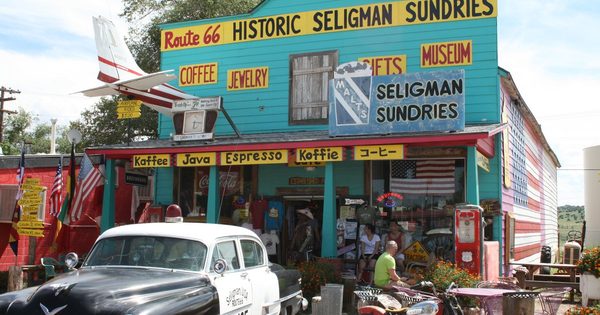
The Historic Seligman Sundries Building — The general store and soda fountain that gave this publication its name occupies a central place in the commercial district’s history. As a community gathering place serving both locals and travelers, it exemplified the hybrid character of Route 66 commerce. Read the full history of Seligman Sundries.
The Preservation Movement Context
The NRHP listing for the Seligman Commercial Historic District did not arise in isolation. It was part of a broader effort to secure legal and cultural recognition for Route 66 communities that had been systematically bypassed and economically devastated by Interstate 40 and its predecessors.
The Historic Route 66 Association of Arizona — founded in Seligman in 1987 at Angel Delgadillo’s initiative — was the organizational engine behind many of these preservation efforts. The association understood, correctly, that historic designation was both an end in itself and a tool for economic revitalization. If Seligman could be recognized as historically significant, travelers would come. If travelers came, the businesses that served them could survive. If businesses survived, the community could endure.
That logic has proven correct. Seligman today draws visitors from around the world — many of them specifically because of the historic district, the preservation story, and the authentic Route 66 character that the commercial buildings embody, and many more drawn by the town’s turn as the real-world model for Pixar’s Radiator Springs.
What the Designation Does Not Protect
It is worth being clear about the limits of historic district designation in Seligman’s case. Private property owners within the district are not required to maintain their buildings or prevent deterioration. Several buildings within the historic district have been lost to fire, neglect, or demolition since the listing was established.
The Arizona State Historic Preservation Office works with property owners and local advocates to encourage appropriate rehabilitation and maintenance, but enforcement mechanisms are limited. The long-term preservation of the Seligman Commercial Historic District depends more on the economic vitality that Route 66 tourism has brought to the town than on any regulatory protection.
Frequently Asked Questions
What buildings are included in the Seligman Commercial Historic District?
The district encompasses the core commercial blocks of downtown Seligman along Historic Route 66, including the Delgadillo Barbershop, the Snow Cap Drive-In, and a range of other commercial buildings dating from the 1920s through the 1960s. A full property list is available through the National Register of Historic Places.
Does NRHP listing prevent demolition or alteration of buildings in Seligman?
No. National Register listing does not impose mandatory preservation requirements on private property owners. It creates eligibility for preservation grants and tax credits but does not prevent demolition or alteration. Protections depend on local ordinances, which are limited in Seligman’s case.
When was the Seligman Commercial Historic District listed on the National Register?
The district’s NRHP listing was part of the broader Route 66 preservation effort that followed the founding of the Historic Route 66 Association of Arizona in 1987. For exact listing dates, the National Register database maintained by the National Park Service is the authoritative source.
Is Seligman worth visiting specifically for its historic architecture?
Yes — but the architecture is best understood as context for the human story rather than as a standalone attraction. The buildings matter because of what happened in them and because of the people associated with them. A visit to the Delgadillo Barbershop, the Snow Cap Drive-In, and the commercial district’s surviving buildings is a visit to a place where American road culture became self-aware about its own value.
Hero image: “Seligman, Arizona on Route 66” by Mike McBey, CC BY 2.0, via Wikimedia Commons (cropped).

.jpg)