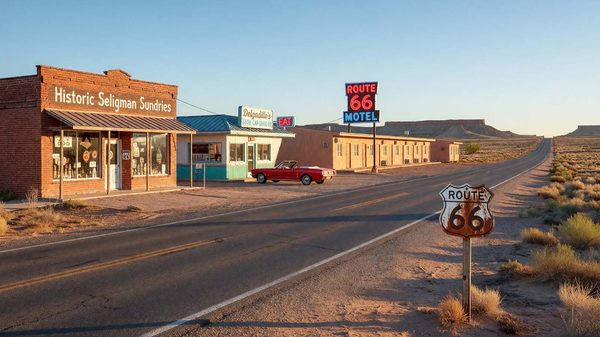
The 90-mile stretch of Historic Route 66 between Seligman and Kingman, Arizona is one of the longest and best-preserved sections of the original highway still in existence. Where other sections of Route 66 have been buried under Interstate alignment or lost to development, this corridor survives largely intact: the same two-lane road, the same towns, much of the same vernacular architecture that travelers encountered in the 1950s and 1960s when this was the main street connecting Chicago to Los Angeles.
Plan four to six hours for the drive with stops. You will pass through towns that time and the Interstate largely bypassed, visit a cave system that has been a roadside attraction since the 1920s, and arrive in Kingman with the particular satisfaction of having actually driven the Mother Road rather than passing over it at 75 miles per hour.
Before You Leave Seligman
If you have not already spent time in Seligman, do that first. The Delgadillo Barbershop, the Snow Cap Drive-In, and the historic commercial district are essential context for everything west of town. Read our complete Seligman visitor’s guide before you get in the car.
Fill your gas tank in Seligman before heading west. Fuel is available at several points along the corridor, but gaps exist and prices vary significantly. Cell coverage on much of the highway between Seligman and Kingman is limited; download offline maps before you leave.
The best direction of travel is west — Seligman to Kingman — because it puts the best stops in sequence and because the afternoon light is better for photography in this direction. If you are coming from Las Vegas, consider driving east from Kingman to Seligman instead.
Seligman to Peach Springs (30 miles)
Leaving Seligman westbound, Route 66 crosses flat high desert terrain at elevation — you are still above 5,000 feet for the first stretch — with the Santa Fe railway tracks frequently visible to the south. The landscape is high desert grassland, juniper, and pinyon, with the occasional volcanic remnant visible in the middle distance.
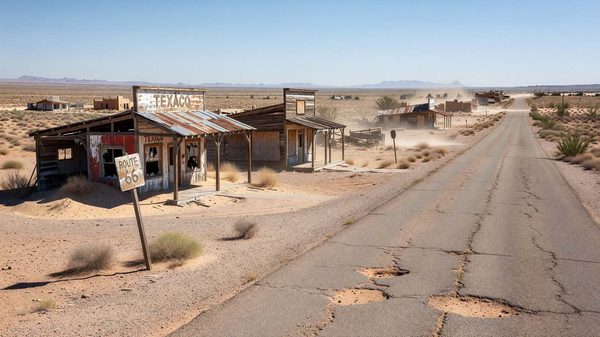
The road is straight and fast for much of this section. There are no significant commercial stops between Seligman and Peach Springs, and cellular coverage drops quickly outside of town. This is Route 66 at its most elemental: two lanes, the horizon, and the road.
Peach Springs is the seat of the Hualapai Tribe and one of the largest communities on this stretch of highway. It sits in a valley at about 4,800 feet elevation. The Hualapai Tribe manages significant tourism infrastructure in the region, including access to the Grand Canyon West rim and Skywalk attraction, and operates Diamond Creek Road — the only road that reaches the Colorado River within the Grand Canyon.
Hualapai Lodge in Peach Springs is a functional motel and restaurant operated by the tribe; it is the best option for accommodation if you are splitting the drive over two days. The lodge restaurant serves breakfast and lunch with a menu that includes Hualapai-influenced dishes alongside American standards.
For visitors interested in the Grand Canyon from a less-visited angle — the western rim, accessed via Hualapai territory rather than the National Park — Peach Springs is the staging point. The Hualapai Nation’s tourism page has current information on Grand Canyon West access and pricing.
Grand Canyon Caverns (11 miles west of Peach Springs)
Grand Canyon Caverns is one of the oldest continuously operating tourist attractions on Route 66 in Arizona, drawing visitors since the 1920s when a cattle rancher named Walter Peck discovered the entrance. The caverns are a dry cave system — no flowing water, which preserves the formations intact — with chambers that descend about 200 feet below the surface.
The cave tours are genuinely worthwhile: the caverns are large, the formations are impressive, and the guides know the history of the site and the Route 66 era well. The main tour takes about 45 minutes. There is also an “Cavern Suite” underground hotel room available for overnight stays — a gimmick, but a memorable one.
Above ground, Grand Canyon Caverns operates a motel, a restaurant, a gift shop, and a small Route 66 museum. The property has the full archaeology of a mid-century tourist stop — layers of signage and infrastructure from multiple decades, some in decay and some in operation — that rewards the kind of patient looking that Route 66 travel encourages.
The Grand Canyon Caverns website has current tour times and pricing. This stop warrants at least 90 minutes; more if you are interested in the cave geology or the history of roadside tourism.
Truxton and Hackberry (35 miles west of Grand Canyon Caverns)
The highway passes through a series of small communities — Truxton, Valentine, Hackberry — each of which retains some evidence of its Route 66 era commercial life alongside the inevitable decay of businesses that lost their economic base when I-40 opened.
Truxton has a small gas station and the historic Frontier Motel and Cafe, which has operated in various forms since the 1950s. The building is worth stopping to photograph even if the business is not currently active.
Valentine was once the site of a Havasupai school and Indian Agency. Little of the original commercial Route 66 fabric survives, but the stretch of highway through Valentine gives a clear picture of the undeveloped rural character of much of this corridor.
Hackberry General Store is the major stop in this section. The original store and gas station has been preserved as a Route 66 gift shop and small museum, with an interior crammed with Route 66 memorabilia, vintage vehicles parked outside, and the visual character of a mid-century general store serving highway travelers. It is operated by volunteers and enthusiasts rather than as a commercial enterprise, and that distinction shows in the quality of care given to the space.
The Hackberry General Store is frequently photographed and featured in Route 66 publications because it exemplifies what these highway commercial stops looked like before the Interstate era. The vintage Corvette and other vehicles outside, the old Mobilgas sign, the weathered exterior — it is one of the most photogenic spots on the Arizona corridor. Allow 30-45 minutes. Its full history — the mining camp it started as, and three ownership changes since 1992 — is covered in its own dedicated guide.
The Approach to Kingman (40 miles west of Hackberry)
From Hackberry, Route 66 descends from the high plateau through a series of curves that put the road at its most dramatic — the Black Mountains come into view, the temperature begins to rise, and the desert transitions from high grassland to lower Mojave character. The National Park Service Route 66 corridor documentation identifies this section as among the most scenically significant on the entire highway.
The road passes through the site of Antares — a former community, now largely gone — and enters the broad valley that leads to Kingman. The last stretch before town follows an alignment close to the original highway through open desert.
Kingman is the largest city on the Arizona segment of Historic Route 66, with a population around 30,000 and a full range of services. The Powerhouse Visitor Center on Andy Devine Avenue houses the Route 66 Museum (admission charged), which is a well-produced exhibit on the history of the highway across its eight-state route. This is worth an hour of your time, particularly if you are new to Route 66 history.
The Beale Hotel and other historic buildings in downtown Kingman give a sense of the city’s railroad and highway era. Andy Devine Avenue — named for the Kingman-born character actor and Roy Rogers sidekick — is the Route 66 alignment through town and features several historic buildings and businesses.
Seasonal Considerations
Spring (March–May) is ideal for this drive. Temperatures are comfortable across the full elevation range — from Seligman’s 5,200 feet down to Kingman at about 3,300 feet — and most businesses along the corridor are open and operating. The Route 66 Fun Run in late April/early May brings a concentration of classic cars to the corridor.
Summer (June–August) is hot, particularly once you descend from the high plateau west of Hackberry. Temperatures in Kingman can reach 105°F in July. Start early, carry more water than you think you need, and be aware that some businesses have reduced summer hours.
Fall (September–November) is excellent. Temperatures moderate, crowds thin, and the afternoon light on the desert takes on qualities that make this one of the most photogenic times of year for the drive.
Winter (December–February) is possible but cold. Snow is possible at Seligman’s elevation. Most businesses along the corridor operate reduced hours or close entirely for the winter. Verify before going.
Practical Notes
- Distance: Seligman to Kingman via Historic Route 66 is approximately 90 miles. Via I-40 it is 75 miles. The time difference is significant: allow at least 4 hours for the historic route with minimal stops, 6+ hours with a full stop program.
- Fuel: Available in Seligman, Peach Springs, Grand Canyon Caverns (limited), and Kingman. Do not leave Seligman with less than half a tank.
- Cell service: Limited to nonexistent between Peach Springs and Hackberry. Download maps in advance.
- Food and water: Carry more than you think you need, particularly in summer.
Frequently Asked Questions
Is the Seligman to Kingman stretch of Route 66 paved?
Yes, the entire historic Route 66 corridor between Seligman and Kingman is paved two-lane highway in varying condition. Some sections have rough pavement or crumbling edges; the road is passable in any standard vehicle but is not recommended for very low-clearance vehicles in a few locations.
Can I do the Seligman to Kingman drive in a rental car?
Yes, without any issues. A standard passenger car is entirely appropriate for this drive.
Are there places to eat between Seligman and Kingman?
Limited options. The Hualapai Lodge restaurant in Peach Springs is the most reliable. Grand Canyon Caverns has a snack bar/restaurant. Carry food and water as backup. Kingman has a full range of restaurants.
What is the best single stop if I only have time for one?
Grand Canyon Caverns is the most distinctive stop — the cave tour is genuinely impressive and the property captures the full character of mid-century Route 66 tourism. Hackberry General Store is the best pure Route 66 atmosphere stop. If you are choosing one, Grand Canyon Caverns.