The gas station was the necessary infrastructure of Route 66 — not a destination but a lifeline. Without fuel stops at regular intervals across the desert Southwest, the journey from Chicago to Los Angeles was not merely inconvenient; it was dangerous. What the gas station became over the decades, however, was something far more interesting than infrastructure. It became architecture, art, salesmanship, and community anchor. The most remarkable examples that survive today are worth a dedicated detour.
The Economics That Built the Stations
Route 66 was officially commissioned in 1926. In its early years, the highway crossed territory that was, in significant stretches, genuinely hostile to automotive travel — the Oklahoma panhandle, the New Mexico plateau, the Mojave Desert. Automotive range in the late 1920s was typically 150-200 miles per tank. Service stations had to appear with sufficient frequency to keep travelers moving.
The result was a proliferation of independent and chain filling stations that, by the highway’s peak in the late 1940s and early 1950s, lined Route 66 in continuous commercial development through towns and at highway intervals between them. Competition for traveler business was intense. Stations differentiated themselves through architecture, service, cleanliness, and the range of amenities they offered — from simple fuel to full mechanical service to cold water and clean restrooms, which in the desert Southwest could be genuinely scarce.
The oil company chains — Conoco, Phillips 66, Texaco, Standard Oil — developed signature architectural vocabularies for their stations. The traveling public came to recognize these forms from a distance, which was itself a form of advertising. A station built to the Phillips 66 template, or the Conoco tower form, communicated brand identity before the driver had pulled off the highway.
The Conoco Tower Stations
The Conoco “tower” stations represent one of the most architecturally distinctive gas station designs ever deployed on Route 66. Built in the late 1920s and early 1930s, these stations feature a tall narrow tower rising above the service bay roof — an element that served both as a wind-directional device (for the pennants that were standard station decoration) and as a highly visible landmark on the flat Oklahoma and Texas plains.
The tower stations built for Conoco in Oklahoma are particularly well-preserved examples. The Chelsea, Oklahoma Conoco station — dating to 1929 — is considered one of the earliest surviving gas stations on the entire Route 66 corridor and has been documented by preservation groups as a significant example of highway commercial architecture. It operated continuously into the 1990s before becoming a preservation project.
These stations were also community anchors. In small towns along the route, the gas station was often the first contact travelers had with the town’s population, and its operators served as informal information centers, guides, and — in breakdowns — emergency assistance coordinators.
The Texaco Art Deco Period
The 1930s brought a significant aesthetic shift in gas station design, driven partly by the cultural influence of the 1933 World’s Fair and the broader Art Deco movement. Texaco’s mid-thirties redesign produced the “Streamline Moderne” station form — smooth white porcelain-enameled panels, horizontal banding, a flat canopy roof, and a visual vocabulary borrowed from ocean liner design.
The Texaco “Type C” station design, introduced in 1937, was probably the most widely replicated gas station form in American highway history. Hundreds were built along Route 66. The aesthetic said: modern, clean, standardized, trustworthy. In the pre-interstate highway era, trust was a significant commercial asset — a recognizable brand architecture signaled that the fuel quality, restroom condition, and mechanical service standards would meet expectations.
Of the original Texaco Streamline stations on Route 66, relatively few survive in recognizable form. The conversion of former gas stations to other uses — convenience stores, repair shops, retail spaces — has typically obscured or destroyed the original architectural elements. Intact examples, when found, tend to be in the smaller towns where redevelopment pressure was lower.
The Shamrock Tower Station: A Route 66 Icon
The Tower Station and U-Drop Inn in Shamrock, Texas, is among the most photographed buildings on the entire Route 66 corridor. Designed by architect J.C. Berry in 1936, it combines a tilted conical tower (actually a spindle-shaped finial surmounting a rounded tower form) with a sweeping curved canopy in a composition that reads as genuinely futuristic from any distance.
The Tower Station is listed on the National Register of Historic Places and is a designated Texas Historical Landmark. It has served as a Chamber of Commerce office and is open to visitors year-round. The building was one of the direct design inspirations for Ramone’s House of Body Art in Pixar’s Cars, extending Route 66 architectural influence into a global animated property.
The Independent Operators
For every chain station, there were dozens of independent operators — family businesses that had secured a supply contract with a regional distributor and built their station to the minimum code requirements of their era. These independent stations were more varied architecturally and more deeply embedded in local community identity. They were also more vulnerable.
When the Interstate Highway System bypassed Route 66 town by town through the 1960s and 1970s, independent gas stations were the first businesses to close. Fuel demand dropped almost overnight when the through traffic shifted to the Interstate, and an independent station’s economics depended almost entirely on highway travelers.
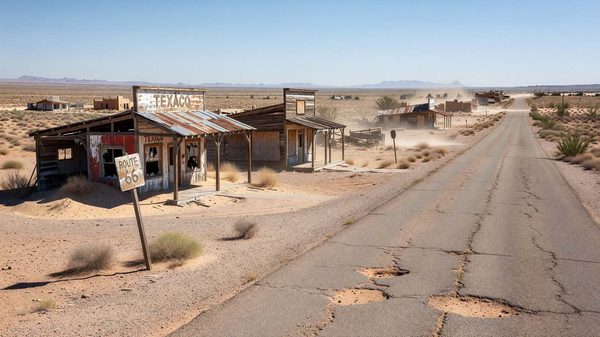
The stations that survived were ones where the owners found alternative purposes — storage, repair, or simply continuation as locals-only stations serving the drastically reduced population of bypassed communities. Many survive as shells: the pump islands are still there, the canopy is still there, the building is still there, but it has been decades since anyone fueled a car.
This is the form most visible today to Route 66 travelers — the ghost station. Empty, marked by its former function, often with enough architectural character remaining to communicate what it once was. The Hackberry General Store in Arizona (formerly the Hackberry Conoco station) is one of the most photographed examples of the ghost-station-turned-visitor-attraction format, operating as a gift shop and museum within the original station structure.
The Preservation Landscape
Preserving Route 66 gas stations has been an ongoing challenge because the buildings sit on privately owned land, are often not generating income, and require continuous maintenance investment to prevent deterioration. The Route 66 Corridor Preservation Program, administered by the National Park Service, has provided matching grants for the preservation of historic properties along the corridor — including gas stations — since 1999. The program has helped stabilize dozens of structures that would otherwise have been lost.
State historic preservation offices in the eight Route 66 states (Illinois, Missouri, Kansas, Oklahoma, Texas, New Mexico, Arizona, California) have been inconsistent in their attention to highway commercial buildings, which often fall outside the architectural categories that preservation programs historically prioritized. Individual advocates — often members of state Route 66 associations — have been the most consistent force for documenting and protecting surviving stations.
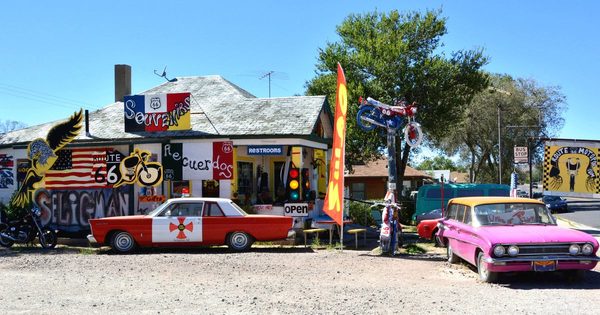
In Seligman, the historic commercial district that includes the original station sites is part of the Seligman Commercial Historic District listed on the National Register. The listing provides some protection and makes eligible for preservation incentives the buildings that gave the town its character.
Frequently Asked Questions
What is the oldest surviving gas station on Route 66?
The 1929 Conoco station in Chelsea, Oklahoma is frequently cited as one of the earliest surviving gas station buildings on Route 66. Other claimants include stations in Missouri and Illinois. Because early stations were often simple structures that were extensively modified over time, establishing “oldest” requires careful attention to what remains original.
What happened to most of the gas stations along Route 66?
Most closed when Interstate 40 bypassed their communities and eliminated the through traffic that had sustained them. Some were demolished; others were converted to other uses. A significant number survive as empty structures — the pump islands and canopy intact, the building in varying states of deterioration, the business long gone. These ghost stations are among the most compelling artifacts of the bypassed highway.
Why are Route 66 gas stations architecturally significant?
Gas station architecture on Route 66 represents an intersection of commercial competition, brand identity building, and the broader aesthetic movements of the 1920s-1950s. The Conoco tower, Texaco Streamline, and independent vernacular designs were developed specifically to attract highway travelers — making them among the earliest examples of purpose-built highway commercial architecture in the US.
Can I visit historic Route 66 gas stations?
Several survive in accessible form. The Tower Station and U-Drop Inn in Shamrock, Texas is open to visitors. The Hackberry General Store in Arizona operates as a visitor stop within a former Conoco station. The Blue Swallow Motel in Tucumcari, New Mexico (with its attached station garage) is listed and operable. Driving the historic corridor between Seligman and Kingman passes multiple former station sites in varying states of preservation.
Further Reading from Authoritative Sources
- National Park Service — Route 66 Corridor Preservation Program — Details the NPS grant program that has funded preservation of historic gas stations and other Route 66 properties.
- Smithsonian Magazine — The Architecture of American Road Trips — Historical overview of how Route 66 commercial architecture developed and what has been preserved.
Hero image: “Cool Springs Station” by The Greater Southwestern Exploration Company, CC BY 2.0, via Wikimedia Commons (cropped).
.jpg)