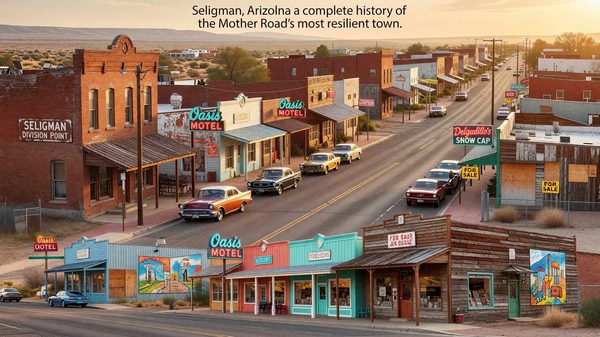
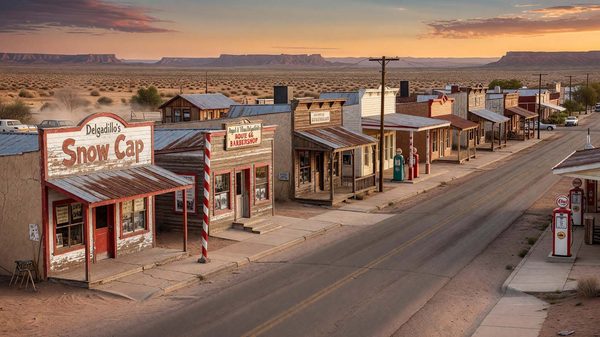
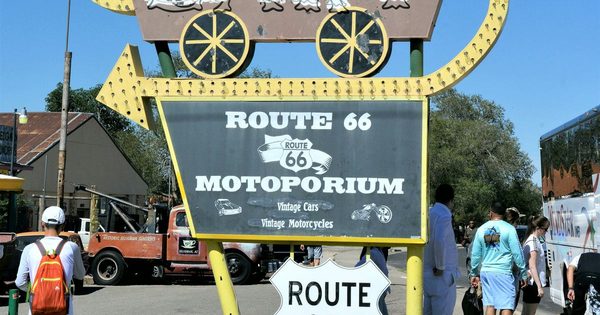
Drive into Seligman, Arizona today and the signs tell you two things before you reach the first storefront: this is the Birthplace of Historic Route 66, and the town was established in 1886. The first claim is a story of the 1980s, well told elsewhere. The second is older, stranger, and far less known — because before Seligman was a Route 66 town, before it was even called Seligman, it was a railroad junction in the high-desert grass with a different name entirely.
This is the story of how a place called Prescott Junction became Seligman, and why a small Arizona town ended up carrying the name of a New York banking family that most of its residents would never meet.
Before the Name: A Railroad Crosses the High Desert
In the early 1880s, the Atlantic & Pacific Railroad pushed its transcontinental line west across northern Arizona, following the 35th parallel route that surveyors had identified decades earlier as the practical path through the territory — a corridor of relatively gentle grades through juniper and pinyon country at around 5,000 feet of elevation. The line passed through the future sites of Holbrook, Winslow, Flagstaff, Williams, and on toward the Colorado River, stitching together the string of towns that would later, almost exactly, become the path of Route 66 across Arizona.
The railroad needed water stops, section camps, and junction points along the way. One of those points sat in the open grassland of the Aubrey Valley in what is now western Yavapai County. There was little there to recommend the spot except geography: it was where a branch line could plausibly run south toward the territorial capital at Prescott.
Prescott Junction, 1886
That branch line — the Prescott & Arizona Central Railway — was completed in 1886, connecting Prescott to the Atlantic & Pacific mainline. The point where the two railroads met needed a name, and it got the most literal one possible: Prescott Junction.
This is the founding moment behind every “EST. 1886” sign in town. The settlement that grew up at the junction was a working railroad place from its first day — a depot, section housing, and the handful of businesses that serve train crews and travelers. It was not founded by homesteaders or miners or visionaries. It was founded by a timetable.
The Prescott & Arizona Central itself did not last. The branch was plagued by financial and operational troubles, and within a few years a competing line from Ash Fork — a few miles east on the mainline — took over the Prescott traffic. The junction lost its junction. But by then the settlement had something more durable than a branch line: the mainline railroad had use for it, and it had a new name.
Enter the Seligmans: The Money Behind the Rails
Railroads in the 1880s were built less with shovels than with capital, and the capital came from banking houses in New York and Europe. Among the most prominent was J. & W. Seligman & Co., the firm built by the Seligman brothers — German-Jewish immigrants who had risen from frontier peddling to international finance in a single generation, and whose firm helped underwrite United States government debt during the Civil War before turning heavily to railroad finance.
The Seligman firm was deeply involved in financing the Atlantic & Pacific Railroad’s construction across the Southwest. Naming the station for the family followed the standard practice of the railroad era: stations and towns along new lines were routinely named for the financiers, directors, and business allies whose goodwill — and continued investment — the railroad depended on. Jesse Seligman, a senior partner in the firm, is the family member most often cited in connection with the town’s name, and our complete history of Seligman places the naming in the broader arc of the town’s three economic eras.
So Prescott Junction became Seligman. The town kept the railroad; the railroad’s bankers got the map.
There is a probably-apocryphal footnote that locals enjoy: the Seligman family, the story goes, was never entirely pleased that the town pronounced its name SLIG-mun rather than the family’s SEL-ig-man. Whatever the family thought, the local pronunciation won — listen to anyone raised in town, including the Delgadillo family, and you will hear it.
From Junction to Division Point
The name change coincided with the town’s growth into something more substantial than a junction. The Atlantic & Pacific was absorbed into the Atchison, Topeka and Santa Fe Railway system in the 1890s, and around the turn of the century the Santa Fe made Seligman a division point — the place where train crews changed, locomotives were serviced, and the railroad concentrated its operational infrastructure for that stretch of the line.
A division point meant payroll, and payroll meant a town. Seligman gained a roundhouse, a substantial depot, and in 1905 a Fred Harvey establishment — the Havasu — serving meals to passengers and crews with the white-tablecloth standards the Harvey company brought to the entire Santa Fe system. The commercial district that took shape along the tracks in those years became the bones of the historic main street that travelers walk today, much of it now listed on the National Register of Historic Places as the Seligman Commercial Historic District.
The National Park Service, which documents the town’s railroad-era origins as part of its Route 66 travel itinerary, notes this layered history directly: the highway town that Cars fans come to see was a railroad town first, and its street grid, its building stock, and its name all date from the rail era. The NPS Route 66 Corridor Preservation Program treats these railroad-era commercial districts as an essential chapter of the Mother Road’s story — the road, after all, followed the rails.
Why the Name Stuck When Everything Else Changed
Seligman has survived three economic deaths: the decline of steam-era railroad employment, the 1978 Interstate bypass that cut off its highway lifeblood, and the long quiet years before the preservation movement that began in its own barbershop brought the travelers back.
Through all of it, the name never changed — which is mildly remarkable, given how arbitrary it was. The Seligman family had no enduring connection to the town. The banking house that put the name on the map dissolved into financial history. But town names are sticky in a way that economies are not, and by the time Route 66 arrived in 1926, “Seligman” was simply where you stopped for gas and a meal between Ash Fork and Peach Springs.
There is something fitting in that. A town named for distant financiers became famous, a century later, for exactly the opposite quality: the stubborn local loyalty of people like Angel Delgadillo, who stayed when the traffic left and organized the movement that saved the highway. The name came from New York. Everything the name now stands for came from the town itself.
Frequently Asked Questions
When was Seligman, Arizona founded?
Seligman was established in 1886, originally as Prescott Junction — the point where the Prescott & Arizona Central Railway branch met the Atlantic & Pacific Railroad’s transcontinental mainline across northern Arizona. The “EST. 1886” signs around town refer to this railroad founding.
Who was Seligman, Arizona named after?
The town was renamed for the Seligman family of J. & W. Seligman & Co., the New York banking house that helped finance the Atlantic & Pacific Railroad. Jesse Seligman, a senior partner in the firm, is the family member most commonly cited. Naming stations for railroad financiers was standard practice in the 1880s.
What was Seligman called before it was Seligman?
Prescott Junction. The name described its original function: the junction where a branch railway departed the transcontinental mainline for Prescott, then the territorial capital of Arizona. When the branch line failed and traffic shifted to a competing route from Ash Fork, the junction role faded and the new name took hold.
How do you pronounce Seligman?
Locals say SLIG-mun, two syllables — not SEL-ig-man. Local lore holds that the namesake banking family preferred the three-syllable version, but the town’s pronunciation has been settled for generations.
Was Seligman a railroad town before it was a Route 66 town?
Yes. Seligman existed for forty years before Route 66 was commissioned in 1926. It grew as a Santa Fe Railway division point with a roundhouse, depot, and Fred Harvey eating house, and the highway followed the railroad corridor through town — as it did across most of northern Arizona.