When Pixar’s Cars was released in June 2006, the fictional town of Radiator Springs was described in press materials as a composite of Route 66 communities — an amalgamation of places and people from the full length of the highway. That is true as far as it goes. The film’s production team drove Route 66 extensively during development and drew visual and narrative inspiration from dozens of sources.
But Seligman, Arizona is the primary inspiration, and anyone who has spent time in both the film and the town will recognize the overlap. The story of a small community bypassed by an Interstate, struggling to survive economically while holding onto its identity — and eventually finding renewal through travelers who rediscover the old road — is Seligman’s story, compressed and animated and given a talking race car.
The Pixar Research Trip
The development of Cars involved an unusual amount of primary research. The production team, led by director John Lasseter, drove the full length of Route 66 multiple times during the film’s gestation. Lasseter has spoken publicly about the emotional impact of this research: seeing the bypassed communities, meeting the people who had stayed, understanding what had been lost and what had survived.
The team visited Seligman and met Angel Delgadillo. Angel’s story — a third-generation Seligman resident who organized the 1987 preservation meeting that saved Route 66 — became the template for Doc Hudson, the Pixar character played by Paul Newman. The parallels are not exact (Doc Hudson is a racing champion, not a barber) but the emotional core is the same: an older man with deep roots in a bypassed town, carrying the weight of its history, initially resistant to the disruption that Lightning McQueen brings and eventually the key to his own and the town’s renewal.
Read the full story of Angel Delgadillo’s preservation work.
What Radiator Springs Borrows from Seligman
Several specific elements of Radiator Springs trace directly to Seligman:
The general geography and town layout — Radiator Springs sits on a two-lane highway that was once the main route west, bypassed by a superhighway visible in the distance. The town’s commercial strip of derelict and semi-functional businesses, the neon that comes alive in the film’s famous sequence, and the scale of the community all match Seligman’s character.
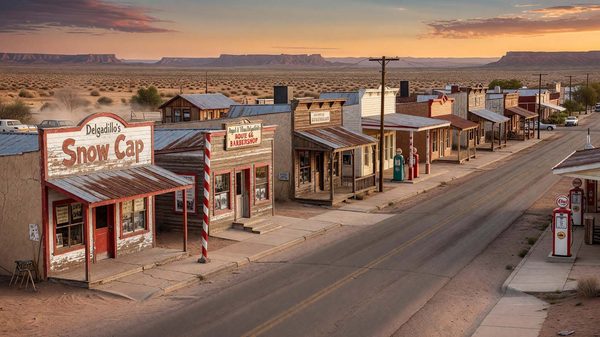
Flo’s V8 Cafe — Flo’s diner in Radiator Springs is understood to draw from roadside diners and drive-ins along the Route 66 corridor. In Seligman’s case, the Snow Cap Drive-In is the obvious reference point: a small, idiosyncratic roadside food stand operated by a family with strong personalities and deep roots in the community.
Luigi’s Casa Della Tires — The Italian character operating an auto-related business on Route 66 is a reference to the actual Italian-American businesses that appeared along the highway during its commercial prime.
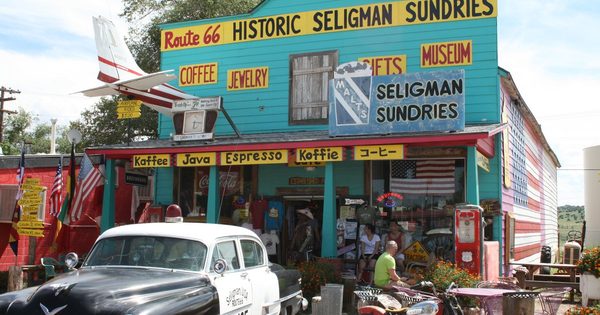
The general store — The Ramone’s House of Body Art occupies a building in Radiator Springs that in scale and position echoes the commercial anchor businesses that defined Route 66 town centers. In Seligman, the role of community anchor was played by the Seligman Sundries general store and soda fountain. Read the history of the original Seligman Sundries.
What Comes from Other Towns
The filmmakers have been consistent in noting that Radiator Springs is a composite, and several elements are drawn from other sources:
Calhoun, Texas and Galena, Kansas contributed specific visual references. The rusted water tower in Radiator Springs echoes towers in several midwestern Route 66 communities.
Tucumcari, New Mexico — with its famous Tee Pee Curios and motel strip — influenced the visual character of Radiator Springs at night, particularly the neon sequence.
Holbrook, Arizona’s Wigwam Motel (the actual Wigwam Motel at 811 W. Hopi Drive) inspired Cozy Cone Motel — the cone-shaped motel operated by Sally in the film. The real Wigwam Motel, with its concrete teepee-shaped rooms, has been operating since 1950 and is listed on the National Register of Historic Places.
The PBS American Experience documentary on Route 66 and coverage in publications including USA Today’s Route 66 coverage have traced these connections in detail.
The Effect on Seligman
The release of Cars in 2006 transformed Seligman’s tourism economy in ways that the preservation movement alone had not. The preservation movement brought Route 66 enthusiasts — a dedicated but relatively small group. The movie brought families with children who recognized the town from a film they had watched dozens of times.
The volume of visitors to Seligman increased substantially in the years after the film’s release. The town was covered by national and international media as the real Radiator Springs. Gift shops began selling Cars merchandise alongside Route 66 memorabilia. Visitors arrived from Japan, Germany, Brazil, and Australia — countries with no particular connection to Route 66 history but with deep affection for the Pixar film.
This was economically significant for a town of 450 people. Seligman had already developed a functioning tourism economy through the preservation movement, but the Cars effect amplified it and brought a demographic — families with young children — that the Route 66 heritage market alone had not reliably attracted.
The Complicated Question of Authenticity
The relationship between Seligman’s identity as the “real Radiator Springs” and its identity as a historic Route 66 community is not entirely comfortable. Some longtime Route 66 advocates have expressed concern that the Cars framing reduces a serious preservation story to a theme park attraction — that visitors come looking for Lightning McQueen rather than the actual history of the road and the community.
There is something to this concern. A family that visits Seligman primarily to see the “real Radiator Springs” may leave without understanding why the town matters, what was at stake in 1987, or what it means that this community survived. The historic significance and the animated film are competing frames, and the film is, for many visitors, the more immediately accessible one.
The counterargument is that the Cars connection brings people who would not otherwise come, and that once they are in Seligman, the actual history is available to them. Angel Delgadillo’s barbershop is a few blocks from wherever they parked. The commercial district is right there. The story is accessible to anyone who wants to hear it.
Both things can be true: the Cars connection has been economically beneficial and culturally complicated. Seligman has managed the balance better than some communities might have, in part because the human story — Angel, Juan, the 1987 meeting, the preservation movement — is strong enough to hold its own against any cartoon framing.
Visiting Seligman with Kids
If you are bringing children who know the Cars films, Seligman is a genuinely good stop. The Snow Cap Drive-In — with its visual character and the spirit of Juan Delgadillo’s humor still present — is the most directly evocative stop. The commercial district has multiple souvenir shops with Cars merchandise and Route 66 memorabilia.
What is worth doing, if your children are old enough to engage with a more complex story, is explaining what actually happened here. The story of a town that refused to give up, of a barber who called a meeting and changed the fate of a road that crossed an entire continent — that is a better story than the movie, and it is real.
Read the complete Seligman visitor’s guide for practical details on the town. And if you want to experience the kind of open, two-lane road the film romanticizes, the historic stretch from Seligman west to Kingman is the most rewarding drive in the area.
Frequently Asked Questions
Is Seligman the only inspiration for Radiator Springs?
No. Pixar’s production team has described Radiator Springs as a composite of Route 66 communities from across the highway’s full length. However, Seligman is the primary inspiration for the town’s overall character and narrative — the bypass story, the preservation movement, and the Delgadillo family’s role are all specifically drawn from Seligman.
Was Angel Delgadillo involved in the making of Cars?
Yes. Angel and other Route 66 figures consulted with the Pixar production team during the film’s development. Angel has spoken publicly about his interactions with John Lasseter and the research process.
Which character is based on Angel Delgadillo?
Doc Hudson — the older car who turns out to have a hidden racing past and who becomes the emotional center of the film’s second act — is understood to be the primary Delgadillo-influenced character, though the parallel is thematic rather than biographical. Angel is a barber, not a racing champion.
Did Cars 2 or Cars 3 also reference Seligman?
The original Cars is the film with the strongest Seligman connection. The sequels moved the franchise in different directions and do not engage as specifically with Route 66 history. The first film remains the one most closely tied to the actual preservation story.
Hero image: “Seligman-Ruta 66-2022 (11)” by Alberto-g-rovi, CC BY 3.0, via Wikimedia Commons (cropped). Depicts the real Seligman, Arizona storefront and streetscape — no Disney/Pixar imagery.
.jpg)